Understanding the Red-winged Starling: A Bird of Unique Charm
Introduction
The Red-winged Starling (Onychognathus morio) is a striking bird species found in various parts of Africa, known for its distinctive appearance and intriguing behavior. This bird is a member of the starling family, Sturnidae, which is renowned for its diverse and highly adaptive species. In this article, we delve into the fascinating world of the Red-winged Starling, exploring its habitat, physical characteristics, behavior, and the role it plays in its ecosystem.
Habitat and Distribution
Red-winged Starlings are widely distributed across sub-Saharan Africa. They can be found in a variety of habitats, including savannas, woodlands, and urban areas. These birds have adapted remarkably well to human-altered environments, often seen in cities and towns where they exploit the abundance of resources. They are commonly found in eastern and southern Africa, with their range extending from Ethiopia down to South Africa.
The adaptability of the Red-winged Starling to different environments is a testament to its resilience. While they thrive in natural habitats, their presence in urban areas indicates their ability to coexist with human populations, a common trait among many starling species.
Physical Characteristics
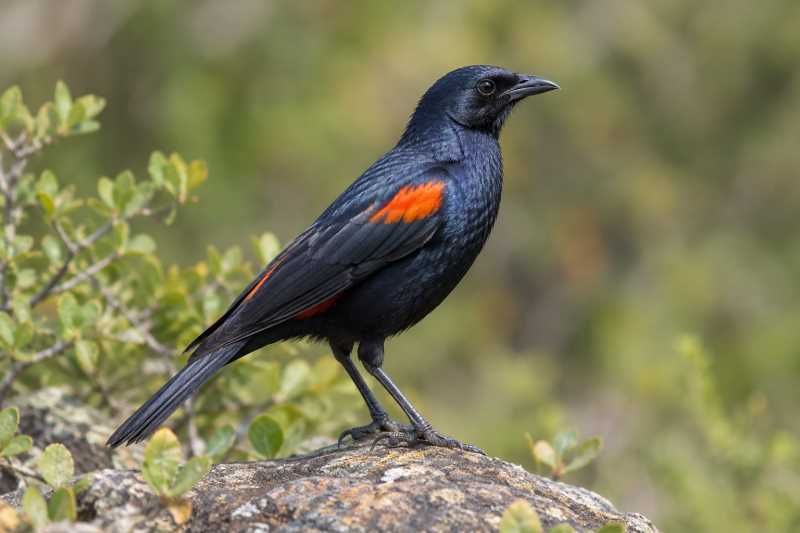
One of the most striking features of the Red-winged Starling is its glossy plumage. The bird exhibits sexual dimorphism, with males and females differing slightly in appearance. Males possess a glossy black plumage with vibrant, reddish-brown patches on their wings – a feature that gives the species its name. Females are slightly duller, with a more brownish hue to their plumage, but they too exhibit the distinctive wing coloration.
Both genders have long tails and strong, pointed beaks, which they use effectively for foraging. Their eyes are a vivid yellow or orange, providing a stark contrast to their dark feathers. The combination of these features makes the Red-winged Starling a visually captivating bird, easily recognizable in the wild.
Behavior and Diet
Red-winged Starlings are social creatures, often seen in pairs or small flocks. They are known for their loud and varied vocalizations, which include whistles, clicks, and squawks. These calls are used for communication within the flock and play a critical role during the breeding season.
The diet of the Red-winged Starling is omnivorous, consisting mainly of fruits, seeds, and insects. They are also known to scavenge for human food in urban areas, further illustrating their adaptability. Their foraging behavior often involves probing into crevices and under foliage to find food, showcasing their resourcefulness.
Breeding and Nesting
Breeding season for the Red-winged Starling varies across its range but generally occurs during the warmer months. These birds are monogamous and often return to the same nesting sites year after year. Nests are typically built in crevices, cliffs, or man-made structures, using grass, twigs, and other materials.
The female typically lays 2-4 eggs, which she incubates for about two weeks. Both parents partake in feeding the chicks, which fledge approximately three weeks after hatching. The cooperative nature of their breeding behavior ensures a higher survival rate for the offspring.
Ecological Role and Conservation
The Red-winged Starling plays a significant role in its ecosystem. As both a seed disperser and a predator of insects, it helps maintain ecological balance. In urban settings, they contribute to controlling insect populations, providing a natural form of pest management.
Currently, the Red-winged Starling is not considered a threatened species. Its adaptability to various environments, including urban areas, has helped maintain stable population levels. However, habitat destruction and urbanization continue to pose potential threats. Conservation efforts focus on preserving natural habitats and ensuring that urban areas remain hospitable to these birds.
Conclusion
The Red-winged Starling is a fascinating species that embodies adaptability and resilience. Its ability to thrive in diverse environments makes it an integral part of both natural and urban ecosystems. Understanding the habits and needs of this bird can help in crafting effective conservation strategies, ensuring that this beautiful species continues to grace the skies of Africa for generations to come.
As urbanization expands, the Red-winged Starling serves as a symbol of nature’s ability to adapt and coexist with human development, reminding us of the importance of preserving biodiversity in all its forms.
Related posts