
The Majestic Long-tailed Hawk: A Comprehensive Overview
The Long-tailed Hawk, scientifically known as Urotriorchis macrourus, stands as a remarkable avian species within the Accipitridae family, captivating ornithologists and bird enthusiasts alike. Known for its striking appearance and intriguing behavioral patterns, this bird of prey is a testament to nature’s diversity and adaptability.
Physical Description
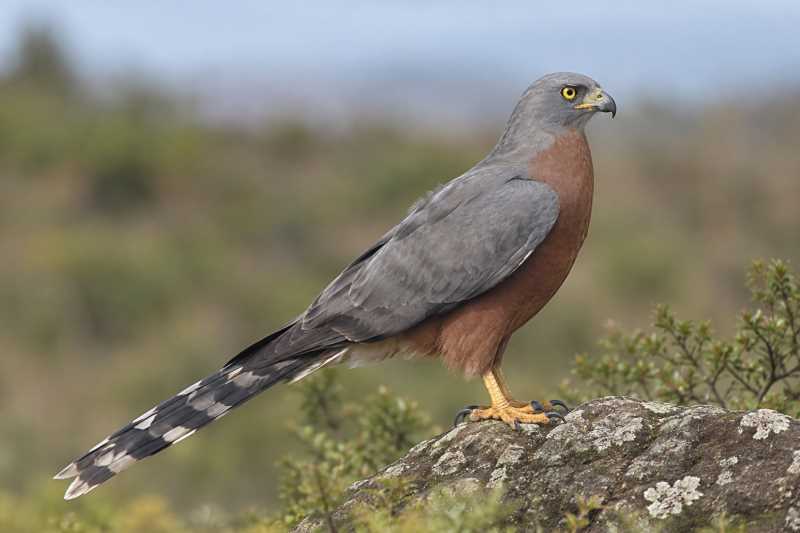
The Long-tailed Hawk is a medium-sized bird, with a length ranging between 50 to 60 centimeters and a wingspan that can extend up to 90 centimeters. Its most distinctive feature is its long, narrow tail, which accounts for nearly half of its body length. This tail, often described as paddle-shaped, aids in its agile flight through dense forest canopies.
The plumage of the Long-tailed Hawk is predominantly dark brown, with lighter underparts. Its head is marked by a unique combination of a black cap and a white throat, providing a stark contrast that enhances its regal appearance. The eyes are a piercing yellow, offering a sharp, watchful gaze that is characteristic of raptors.
Habitat and Distribution
Native to the African continent, the Long-tailed Hawk primarily inhabits the tropical and subtropical forests of West and Central Africa. Countries such as Sierra Leone, Liberia, Ghana, and Cameroon boast populations of this elusive bird. Due to its preference for dense, undisturbed forest habitats, the Long-tailed Hawk often remains out of sight, making it a challenging subject for ornithological study.
Behavior and Ecology
The Long-tailed Hawk is a solitary and elusive hunter, primarily preying on small mammals, birds, and reptiles. It exhibits a unique hunting strategy by utilizing its long tail to maneuver through dense foliage at high speeds, allowing it to surprise its prey. Its diet mainly consists of squirrels, bats, and small birds, which it captures with swift, calculated strikes.
This raptor is also known for its vocalizations, which are described as a series of high-pitched whistles. These calls are not only used for communication but also serve as territorial markers, warning other hawks of its presence.
Reproduction and Lifespan
Breeding season for the Long-tailed Hawk typically occurs between November and March. During this period, the hawks engage in elaborate aerial displays, showcasing their agility and strength as part of their courtship rituals. Nests are constructed high in the forest canopy, often in the forks of large trees. These nests are built from sticks and lined with leaves, providing a secure environment for the eggs and later, the chicks.
Clutches usually consist of one to two eggs, which are incubated for approximately 35 days. Both parents participate in feeding and protecting the young, underscoring the species’ cooperative breeding behavior. The fledglings leave the nest after about 40 to 45 days but remain dependent on their parents for several months.
Conservation Status
The Long-tailed Hawk is currently listed as Least Concern by the International Union for Conservation of Nature (IUCN). However, habitat destruction due to logging and agricultural expansion poses a significant threat to its populations. Conservation efforts are essential to preserving its natural habitat and ensuring the species’ continued survival.
Cultural Significance
In various African cultures, the Long-tailed Hawk is revered as a symbol of vision and insight. Its keen eyesight and hunting prowess have made it a subject of folklore and mythology, where it is often depicted as a guide or protector.
Conclusion
The Long-tailed Hawk is a fascinating species that embodies the beauty and complexity of avian life in the African tropics. Its unique adaptations and mysterious nature continue to intrigue scientists and bird watchers, highlighting the importance of preserving our planet’s rich biodiversity. Understanding and protecting such species is crucial in maintaining ecological balance and promoting a sustainable future for all wildlife.
As we advance in our conservation efforts, the Long-tailed Hawk stands as a reminder of the delicate interplay between nature and mankind, urging us to respect and cherish the natural world.
Related posts


