Introduction
The Blue Pitta, Hydrornis cyaneus, is a brightly coloured, ground-dwelling pitta of South and South-East Asia. It belongs to the pitta family, Pittidae, a group of compact forest birds known for vivid plumage, short tails, strong legs and usually secretive behaviour. Despite its striking appearance, the Blue Pitta is often difficult to see because it spends much of its time moving quietly through leaf litter and dense undergrowth.
The species occurs from north-eastern India and Bangladesh through Myanmar, southern China and mainland South-East Asia. Its distribution includes Thailand, Laos, Vietnam and parts of Cambodia. It is generally associated with humid forest, although it can also occupy suitable secondary woodland, bamboo-rich habitats and some drier forest types where ground cover and leaf litter remain intact.
The name Blue Pitta refers mainly to the blue back, wings and tail of the adult male. In some parts of its range, regional forms differ in the strength of their orange, blue and olive tones. Current taxonomic treatments generally recognise three subspecies, although subspecies limits and geographic variation have not always been treated identically by different authorities.
Physical Description
The Blue Pitta is a medium-sized, compact pitta measuring approximately 23 centimetres in length. Like other pittas, it has a stocky body, relatively long legs, a short tail and a broad head. These proportions reflect its largely terrestrial way of life rather than sustained aerial movement.
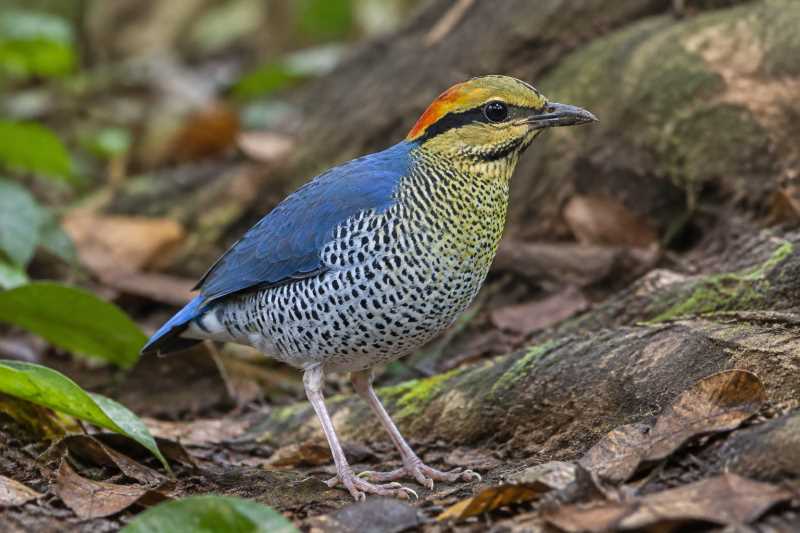
The adult male is particularly distinctive. The upperparts are mainly blue, often with darker blue on the wings and tail. The forehead and crown are yellowish or olive-yellow, while the hindcrown and nape are typically bright orange to orange-rufous. A strong black stripe passes through the eye and extends towards the side of the head. There may also be a darker moustachial or chin marking, although its prominence varies with individual, subspecies and viewing conditions.
The underparts are paler than the upperparts. The breast and belly are generally bluish-grey, pale grey-blue or buff-grey, with fine dark spotting, barring or scaling. The exact contrast between the blue back, orange nape and pale underparts is one of the most useful features for identifying a male in good light.
Females are less brightly coloured. They usually have duller olive or brownish upperparts, a weaker or reduced orange nape and paler underparts. Blue remains visible in the tail and sometimes on the wings or back, but the overall impression is more subdued than that of the male. The sexes can therefore be separated when views are clear, although poorly lit birds, wet plumage and brief glimpses may make the distinction difficult.
Juveniles and immatures are less well documented than adults in many field accounts. Young birds are generally duller, with less sharply contrasting head and neck markings and less saturated blue and orange plumage. The development of adult colouration is gradual, so immature birds may not show the complete pattern of an adult male. Their identification is best supported by location, structure, behaviour and any visible remnants of the species’ characteristic head pattern.
In flight, the Blue Pitta can reveal a small pale or white patch near the base of the primary feathers. This mark is not always visible, but it can be useful when a bird flies low across a trail and disappears immediately into cover. The flight is usually short and direct, often from one patch of undergrowth to another, rather than prolonged.
The bill is fairly stout and suited to picking up invertebrate prey. The legs are strong and adapted to walking, hopping and probing among leaves, roots, moss and fallen branches. These features, combined with the short tail and rounded body, distinguish the Blue Pitta from many more slender woodland passerines.
Range and Habitat
The Blue Pitta has a broad mainland Asian distribution. It is recorded in north-eastern India, Bangladesh, Myanmar, southern China and several countries of mainland South-East Asia, including Thailand, Laos, Vietnam and Cambodia. The species is not considered endemic to a single country and is not normally treated as a long-distance migrant. Most records concern resident or locally moving birds, although movements may occur in response to seasonal conditions, food availability and breeding activity.
Three subspecies are commonly recognised in current taxonomic databases: Hydrornis cyaneus cyaneus, H. c. aurantiacus and H. c. willoughbyi. Their ranges are associated broadly with different parts of the species’ distribution. The nominate form is linked with areas including north-eastern India, Bangladesh, Myanmar, northern mainland South-East Asia and parts of southern China. H. c. aurantiacus is associated particularly with eastern Thailand and adjacent south-western Cambodia, while H. c. willoughbyi is generally associated with central Laos and southern Vietnam. The treatment of regional populations can vary between taxonomic sources, so these divisions are best regarded as a current working framework rather than an absolute statement of evolutionary boundaries. (itis.gov)
The species is most strongly associated with moist broadleaved forest. Important habitat characteristics include a shaded forest floor, deep leaf litter, damp soil, fallen branches, dense low vegetation and access to small clearings or uneven ground where the bird can forage. It may occur in evergreen forest, semi-evergreen forest, moist deciduous woodland, bamboo forest and forest edges where the understorey remains relatively undisturbed.
In India and mainland South-East Asia, Blue Pittas are often reported from hilly or foothill forest, ravines and areas with a humid microclimate. They can use habitats containing mosses, ferns, rocks and rotting timber, particularly where these features support earthworms and other invertebrates. Some records come from relatively open forest-floor situations, including steep banks, old stumps and rocky areas, rather than only from closed-canopy forest.
The species occurs from lowland areas into the hills and may be found at moderate elevations. Exact upper elevation limits vary geographically and are not consistently reported across its range. It is safer to describe the Blue Pitta as a lowland to montane forest bird with a strong association with moist, shaded ground conditions than to assign a single elevation ceiling to every population.
Habitat loss and degradation can affect the species by removing forest cover, drying the forest floor, simplifying understorey vegetation and reducing the leaf-litter habitat used for feeding. Because the Blue Pitta is relatively secretive and dependent on suitable ground conditions, apparently forested landscapes may not be equally valuable if they are heavily disturbed, intensively visited or lacking in dense undergrowth.
Where to See This Species
The Blue Pitta is difficult to see reliably, but several protected areas in Thailand have documented records and are established wildlife-viewing destinations. It is best searched for quietly along forest roads, damp trails, stream crossings and shaded gullies, particularly during periods of activity after rain. Local regulations, seasonal closures and trail restrictions should always be checked before visiting.
Khao Yai National Park, Nakhon Ratchasima and surrounding provinces, Thailand
Khao Yai National Park has the Blue Pitta on its recorded bird list and is one of the better-known places in Thailand to look for forest pittas. The park contains extensive evergreen and mixed forest, damp ravines, streams and shaded trails that provide suitable ground-level habitat. Bird records and field reports indicate that the species can occur on several trails, although it is secretive and sightings are far from guaranteed. (static.thainationalparks.com)
The best approach is to walk slowly and listen for calls rather than expecting a bird to appear in the open. Early morning and periods following rain may be productive, but conditions vary and the species may remain hidden in dense vegetation.
Nearby accommodation: Pak Chong and the communities around the park entrances provide practical accommodation, including hotels, guest houses, homestays, lodges and campsites.
Kaeng Krachan National Park, Phetchaburi and Prachuap Khiri Khan, Thailand
Kaeng Krachan National Park is another documented location for Blue Pitta in Thailand. Its large area of forest, humid valleys, streams, steep slopes and dense undergrowth creates suitable habitat for a ground-foraging pitta. Recent birding records and tour reports have recorded the species in the park, including both sightings and heard-only encounters. (birdquest-tours.com)
The species may be encountered around damp forest tracks, stream crossings and shaded gullies, but it is usually much easier to hear than to see. Visitors should avoid playback overuse and should not use baiting or other methods that alter natural behaviour. Access restrictions and park opening conditions can change seasonally.
Nearby accommodation: Kaeng Krachan village and the wider Phetchaburi gateway area offer guest houses, small resorts, lodges, campsites and other nature-tourism accommodation.
Behaviour and Diet
The Blue Pitta is mainly terrestrial and usually solitary. It spends much of its time walking, hopping and pausing on the forest floor, often beneath low vegetation or beside fallen wood. Its movements can be surprisingly quick, but the bird generally relies on cover rather than flight when disturbed.
It is an inconspicuous species. A bird may remain silent for long periods, move only a short distance and then freeze beneath leaves or vegetation. When alarmed, it may slip into dense cover, fly a few metres and land out of sight, or cross a trail before disappearing into the understorey. This behaviour helps explain why the species can be present in a forest without being detected by casual visitors.
The diet consists mainly of insects and other small invertebrates found in leaf litter and loose soil. Likely prey includes beetles, ants, termites, caterpillars, crickets, spiders and earthworms, although the precise proportions of the diet are not well documented across the whole range. The bird uses its bill to pick prey from the surface, turn leaves, probe soft ground and investigate rotting vegetation.
Foraging is often concentrated in damp places where invertebrates are more accessible. Fallen leaves, mossy banks, stream margins, old stumps and decaying branches may all provide feeding opportunities. The Blue Pitta is not primarily a fruit-eating bird, and its strong legs and ground-foraging posture are more characteristic than any specialised fruit-feeding behaviour.
The species is generally quiet and unobtrusive outside the breeding season, but its calls can reveal its presence. Pitta calls are often clear, repeated whistles or other brief, penetrating notes that carry through dense forest. The Blue Pitta’s vocalisations can be difficult to locate because sound reflects from slopes and vegetation. A calling bird may be on the ground, in low vegetation or briefly perched above the observer’s eye level.
Breeding information is uneven across the range. In parts of the Indian subcontinent and Myanmar, breeding has been reported mainly during the late spring and early summer, while in Thailand nesting may occur later, during the wet season. This difference may reflect regional rainfall patterns rather than a single fixed breeding calendar. Reports describe nests as domed or rounded structures placed close to the ground, including on old stumps, rocks, banks or other concealed sites. The nest entrance is typically positioned on the side.
Both members of a pair are believed to participate in breeding activities, including nest construction and care of young, but detailed observations remain limited compared with those available for more conspicuous forest birds. Because nests are vulnerable to disturbance and predation, visitors should never approach suspected nest sites closely or attempt to expose a bird for photography.
Identification Tips
When identifying a Blue Pitta, concentrate first on structure and habitat, then on colour. The combination of a stocky body, short tail, long legs and ground-level behaviour is characteristic of a pitta. In an adult male, the most useful plumage features are:
- A blue back, wings and tail.
- A yellowish or olive-yellow forehead and crown.
- A bright orange to orange-rufous hindcrown and nape.
- A conspicuous black eye-stripe.
- Pale bluish-grey underparts with fine dark markings.
- A low, direct flight followed by disappearance into undergrowth.
Females are more challenging. Look for the same compact body shape and blue tail, but expect duller olive-brown upperparts, weaker orange on the nape and paler underparts. A female Blue Pitta can appear brownish at first glance, especially in shade, but the blue tail and pitta-like shape remain useful clues.
The Blue Pitta should not be identified solely from a flash of blue. Several pittas in the same broad region show blue, green or orange plumage, and colour can be distorted by low light or wet feathers. A blue-winged pitta, for example, has a different overall pattern and is usually associated with more open or seasonally drier habitats in parts of its range. The Blue-naped Pitta has a blue nape and different body pattern, while the Blue-rumped Pitta is also distinct in its distribution and plumage arrangement. Careful attention to the orange nape, black facial stripe, blue upperparts and pale spotted underparts is important.
Calls can support an identification, but sound alone should be treated cautiously where several pitta species occur together. A recording should not be used repeatedly to draw a shy bird into the open, especially during the breeding season.
Conservation Status
The Blue Pitta is currently assessed as Least Concern on the IUCN Red List. This classification reflects its broad geographic distribution and the fact that it remains present in suitable habitat across a substantial part of its range. It does not mean that every population is secure or that local declines are unimportant. (media.featherbase.info)
A reliable global population estimate is not available, and the species’ overall population trend is not sufficiently documented to justify a precise numerical assessment here. Local abundance can vary considerably. The Blue Pitta may be relatively regular in well-protected, humid forest while being scarce or absent from heavily logged, fragmented or intensively disturbed areas.
The principal conservation concern is the loss and degradation of forest habitat. Agricultural expansion, logging, road construction, settlement growth, fires and removal of understorey vegetation can reduce the quality of habitat available to a ground-foraging pitta. Forest-floor disturbance may be especially significant because the species depends on leaf litter, damp soil and dense low cover for feeding and concealment.
Protected areas remain important, particularly where they conserve large blocks of forest and maintain natural stream systems, understorey vegetation and leaf-litter structure. Effective enforcement against illegal logging, careful management of tourism infrastructure and protection of forest corridors can help maintain local populations. Further field surveys are also valuable because the species’ secretive habits make standard visual counts difficult and may cause it to be under-recorded.
Responsible birdwatching is part of good conservation practice. Observers should remain on permitted trails, avoid flushing birds repeatedly, keep a respectful distance from suspected nests and minimise playback. Photographing a Blue Pitta should never take priority over allowing the bird to forage and move naturally.
Frequently Asked Questions
What is the scientific name of the Blue Pitta?
The scientific name is Hydrornis cyaneus. It is a member of the pitta family, Pittidae. Older literature and some historical bird lists may use the combination Pitta cyanea.
Where does the Blue Pitta live?
The species occurs across mainland South and South-East Asia, including north-eastern India, Bangladesh, Myanmar, southern China, Thailand, Laos, Vietnam and Cambodia. It mainly inhabits moist forest with shaded ground, leaf litter and dense undergrowth.
Is the Blue Pitta migratory?
The Blue Pitta is generally regarded as resident or locally mobile rather than a long-distance migrant. Seasonal movements may occur, but it is not normally treated as a regular long-distance migrant across its range.
What does the Blue Pitta eat?
It feeds mainly on insects and other small invertebrates found in leaf litter and soil. Reported or likely prey includes beetles, ants, termites, caterpillars, crickets, spiders and earthworms.
Is the Blue Pitta endangered?
No. The species is currently assessed as Least Concern by the IUCN Red List. However, local populations may be affected by forest clearance, logging, fragmentation and disturbance of moist forest-floor habitat.
Where is the best place to look for a Blue Pitta?
Khao Yai National Park and Kaeng Krachan National Park in Thailand are documented wildlife-viewing locations for the species. Even in these parks, it is a difficult bird to see. Quietly walking damp, shaded forest trails and listening for calls is usually more effective than searching open viewpoints.
References
- IUCN Red List of Threatened Species
- IOC World Bird List
- BirdLife International
Related posts