The Four-banded Sandgrouse: A Comprehensive Overview
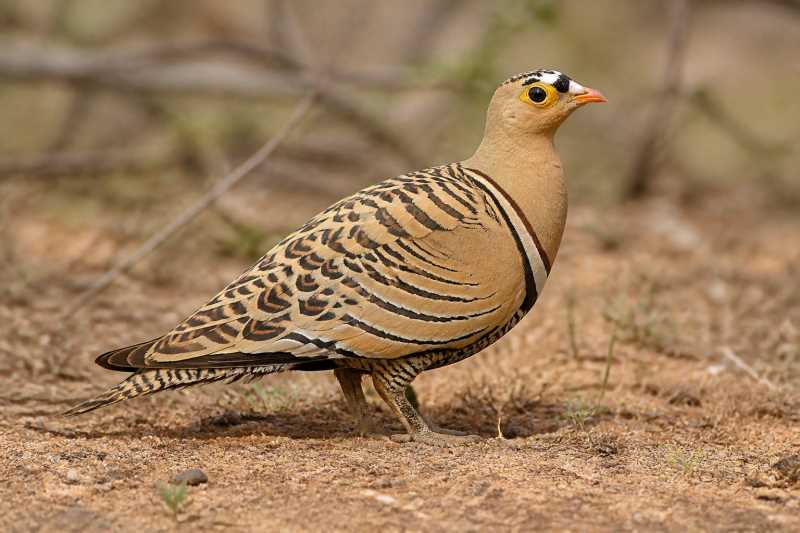
The Four-banded Sandgrouse (Pterocles quadricinctus) is a captivating species of bird that belongs to the family Pteroclidae. Known for its distinctive markings and remarkable adaptation to arid environments, this bird is a subject of fascination among ornithologists and bird enthusiasts alike. In this article, we delve into the unique characteristics, habitat, behavior, and conservation status of the Four-banded Sandgrouse, providing a detailed understanding of this remarkable avian species.
Physical Characteristics
The Four-banded Sandgrouse is easily recognizable by its striking plumage and distinctive markings. Adult males typically display a series of four distinct black bands across their chest, which is the origin of their common name. These bands contrast sharply with their sandy-colored body, providing excellent camouflage in their native habitats. Females, while similarly colored, tend to have a more muted appearance with less pronounced bands, aiding in their role of nesting and protection from predators.
This bird species has a compact body, with a length ranging from 25 to 28 centimeters and a wingspan that stretches approximately 55 to 65 centimeters. Their wings are long and pointed, adaptations that facilitate swift and agile flight, essential for evading predators and covering large distances in search of food and water.
Habitat and Distribution
The Four-banded Sandgrouse is primarily found across the Sahel region of Africa, inhabiting countries such as Senegal, Mali, Niger, and Chad. They are well-adapted to life in arid and semi-arid environments, thriving in open savannas, dry grasslands, and sparse woodlands.
These birds are highly nomadic, often traveling great distances to find suitable feeding grounds and water sources. This nomadic lifestyle is largely driven by the availability of food and water, which can be scarce and unpredictable in their native habitats.
Diet and Feeding Behavior
The diet of the Four-banded Sandgrouse predominantly consists of seeds, grains, and small insects. They have a specialized feeding behavior, often foraging during the cooler hours of early morning and late afternoon to avoid the intense heat of the day.
One of the most fascinating aspects of their feeding behavior is their ability to transport water to their young. Adult sandgrouse will soak their belly feathers in water, which is then carried back to the nest and used to hydrate their chicks. This adaptation is crucial for survival in their arid environments, where water is often a scarce resource.
Reproductive Behavior
Breeding in Four-banded Sandgrouse typically occurs after the onset of rains, which provide an abundance of food resources necessary for raising chicks. Nesting sites are usually simple scrapes in the ground, often located in well-concealed spots to protect from predators.
Females generally lay between two to three eggs per clutch. Both parents share the responsibility of incubating the eggs, which hatch after about 25 days. The chicks are precocial, meaning they are relatively mature and mobile shortly after hatching, allowing them to quickly learn to forage under the guidance of their parents.
Conservation Status
Currently, the Four-banded Sandgrouse is listed as Least Concern on the IUCN Red List. However, like many species inhabiting arid regions, they are susceptible to threats such as habitat loss, climate change, and hunting.
Habitat degradation, driven by agricultural expansion and human settlement, poses a significant threat to their populations. Additionally, climate change impacts, such as altered rainfall patterns and increased frequency of droughts, can affect food and water availability, posing further challenges to their survival.
Despite these challenges, the Four-banded Sandgrouse has shown resilience, with stable population trends observed across much of its range. Continued conservation efforts, focused on habitat protection and monitoring of population trends, are essential to ensure the long-term survival of this remarkable species.
Conclusion
The Four-banded Sandgrouse is a remarkable example of adaptation and resilience in the face of harsh environmental conditions. Its unique physical characteristics, intriguing behavior, and adaptability make it a subject of interest for scientific research and conservation efforts alike. Ensuring the preservation of its habitat and addressing potential threats are vital steps in safeguarding the future of this extraordinary bird species.
For more information on the Four-banded Sandgrouse and related conservation efforts, interested readers are encouraged to consult resources provided by organizations such as BirdLife International and the IUCN.
In conclusion, the Four-banded Sandgrouse stands as a testament to the wonders of avian adaptation and the importance of conservation in maintaining biodiversity across the globe.
Related posts