Introduction
The Perija Starfrontlet (Coeligena consita) is a locally distributed hummingbird of the Serranía del Perijá, a mountain range on the Colombia-Venezuela border. It is recognised as a separate species by the IOC World Bird List and BirdLife International, although some taxonomic treatments have historically regarded it as a form of the Golden-bellied Starfrontlet. Its restricted range and declining habitat make it an important conservation priority.
Physical Description
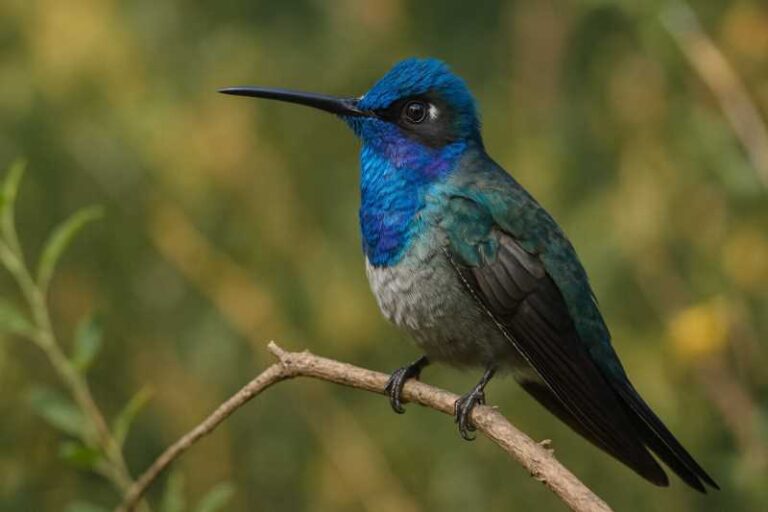
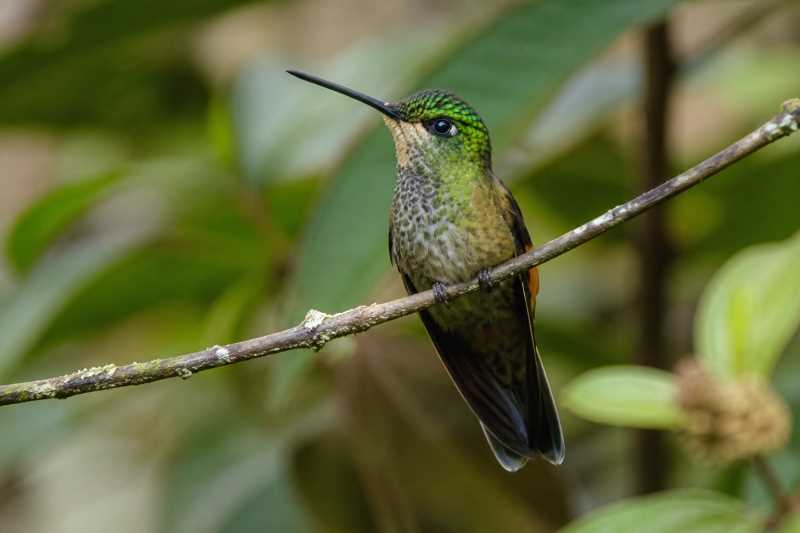
The Perija Starfrontlet is a relatively large, long-billed hummingbird. The male has a dark cap, a green crown, a blue-violet throat patch and a conspicuously golden belly. The wings are brownish with contrasting buff-coloured patches, while the tail is darker and relatively long.
The female is less brightly coloured. It retains the golden belly but has a pale or buff-coloured throat marked with green, together with a long, straight bill. As in other hummingbirds, plumage differences between the sexes are useful identification features. Reliable published measurements are not consistently available, so field identification is best based on structure, elevation and plumage pattern rather than estimated size.
Range and Habitat
The Perija Starfrontlet is endemic to the Serranía del Perijá, which extends across northeastern Colombia and northwestern Venezuela. It is associated with humid montane forest, forest edges, elfin or high-elevation forest and some open habitats at higher elevations. Records extend from approximately 1,400 to 3,200 metres above sea level, although the species is most closely associated with the upper montane zone and páramo margins.
This is understood to be a resident species rather than a long-distance migrant. Its distribution is naturally small and fragmented, leaving it especially vulnerable to the loss of high-elevation forest and other suitable habitat.
Where to See This Species
Serranía del Perijá Regional Natural Park, Cesar, Colombia
The regional natural park protects high-Andean forest and páramo in the Colombian section of the Serranía del Perijá. The Perija Starfrontlet is one of the species recorded as contributing to the park’s biodiversity importance. Look in humid montane forest, forest edges and upper-elevation habitats, particularly where flowering plants are present. Access can be difficult, and local guidance should be arranged before visiting.
Nearby accommodation: Manaure and other settlements in the Cesar foothills provide the most practical base, with guest houses, small hotels and rural accommodation available depending on the route and access arrangements.
Chamicero de Perijá Nature Reserve, Cesar, Colombia
This private nature reserve and birding venue in the Perijá Mountains is regularly used for visits targeting the range’s endemic and restricted birds, including the Perija Starfrontlet. Forest trails, flowering plants and feeding areas around the reserve can provide opportunities to search for the species, although sightings are never guaranteed. Visits should be arranged in advance because the reserve lies in a remote mountain area.
Nearby accommodation: Accommodation is available at or near the reserve in lodge-style facilities, while Manaure and the wider Valledupar area offer additional hotels, guest houses and rural stays.
Behaviour and Diet
The Perija Starfrontlet is active by day and usually forages alone. Like other starfrontlets, it feeds mainly on nectar from tubular flowers and may visit plants including Bomarea, Cavendishia, Fuchsia, Mutisia and Palicourea. It also supplements its diet with small arthropods, which it may glean from foliage, take while hovering or catch in short aerial sallies.
Males may defend productive feeding areas from other hummingbirds. Such territorial behaviour is especially likely where flowering plants are concentrated. The species’ breeding biology remains poorly documented, and detailed information on nesting, clutch size and parental care is limited.
Identification Tips
- Look for a large hummingbird with a long, straight bill in humid montane forest and high-elevation edges.
- In males, the combination of a dark cap, green crown, blue-violet throat patch and golden belly is distinctive.
- Females show a golden belly, a pale throat with green markings and a long bill.
- Buff-coloured wing patches can help separate it from some other Coeligena hummingbirds.
- The species may be confused with related starfrontlets where their ranges approach one another, so elevation, location and the combination of throat, belly and wing markings should all be considered.
Conservation Status
The Perija Starfrontlet is classified as Endangered on the IUCN Red List. Its population is considered to be declining, largely because its already restricted habitat is being lost and fragmented.
Important threats include forest clearance for agriculture and settlement, livestock grazing, mining, fires and illegal cultivation. Conservation measures include protecting remaining montane forest and páramo, improving habitat connectivity, supporting responsible land management and working with local communities. The Serranía del Perijá Regional Natural Park and other protected or privately managed reserves provide important habitat, but effective protection remains challenging in this remote border region.
Frequently Asked Questions
Where can the Perija Starfrontlet be found?
It occurs only in the Serranía del Perijá, a mountain range spanning northeastern Colombia and northwestern Venezuela.
What habitat does the Perija Starfrontlet use?
It uses humid montane forest, forest edges, elfin forest and some open high-elevation habitats, generally between about 1,400 and 3,200 metres.
What does the Perija Starfrontlet eat?
Its diet consists mainly of nectar from tubular flowers, supplemented by small arthropods captured from foliage or taken in flight.
Is the Perija Starfrontlet migratory?
It is generally considered a resident species. There is no reliable evidence of regular long-distance migration.
How can the Perija Starfrontlet be identified?
Males are recognised by their dark cap, green crown, blue-violet throat patch and golden belly. Females have a golden belly, a pale green-marked throat and a long, straight bill.
Why is the Perija Starfrontlet endangered?
Its small range is being affected by habitat loss and fragmentation caused by agriculture, grazing, mining, fires, settlement and illegal cultivation.
References
- BirdLife International
- IUCN Red List of Threatened Species
- IOC World Bird List
Related posts