Introduction
The Green Inca, Coeligena conradii, is a medium-sized hummingbird of the northern Andes. It occurs in humid montane cloud forests and their edges in north-eastern Colombia and north-western Venezuela. The species was formerly treated as a form of the Collared Inca, Coeligena torquata, but is recognised as a separate species by the IOC World Bird List and BirdLife International.
Physical Description
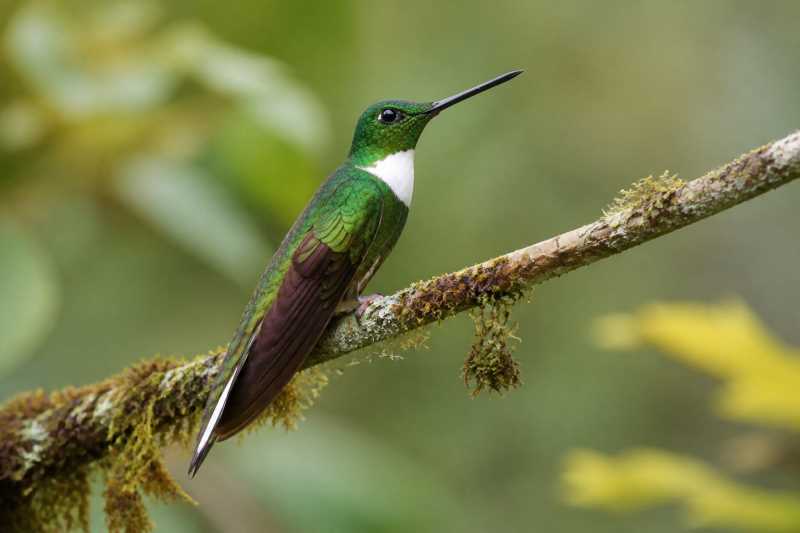
The Green Inca is a long-billed hummingbird measuring approximately 13–14 cm in length. It has a long, straight black bill, brownish wings and a slightly forked tail with largely white outer feathers tipped green.
Adult males are predominantly grass-green, with a broad white collar across the upper breast. Their plumage can appear brightly iridescent in suitable light. Females are also green above but have a narrower white collar and a cinnamon or rusty throat marked with green spots. The remaining underparts are greyish with green mottling and spotting.
These differences in male and female plumage are useful for identification and were among the features that helped support the species’ separation from the Collared Inca.
Range and Habitat
The Green Inca has a restricted Andean distribution. It occurs in the eastern Andes of Colombia, particularly in Norte de Santander and the Tamá region, and in north-western Venezuela from Trujillo and Mérida towards northern Táchira.
It is associated with humid montane cloud forest, especially the lower forest layers, forest edges and shrubby clearings. Most records come from approximately 1,800–3,000 metres above sea level, although it can occur as low as about 1,500 metres in suitable habitat.
The species is considered resident rather than migratory. Its distribution is geographically limited, and the Colombian portion of its range appears particularly restricted. Local variation in plumage has contributed to taxonomic discussion within the former Collared Inca complex.
Where to See This Species
Sierra Nevada National Park, Mérida State, Venezuela
The Green Inca is included in bird checklists for Sierra Nevada National Park, where humid high-elevation forest provides suitable habitat. The Tabay area and forested mountain routes around Mérida offer practical bases for searching, although sightings are not guaranteed and careful observation of the lower forest and flowering plants is required.
Nearby accommodation: Mérida and Tabay provide guest houses, hotels, lodges and self-catering accommodation suitable for visits to the park.
Páramos El Batallón y La Negra National Park, Mérida State, Venezuela
Green Inca records have been documented from the park’s montane habitats, including the Tovar–Guaraque area. Forest edges, humid woodland and adjacent high-elevation vegetation are the most promising places to look, particularly where flowering plants attract hummingbirds.
Nearby accommodation: Tovar, Bailadores and surrounding mountain settlements provide guest houses, small hotels, lodges and other basic accommodation.
Behaviour and Diet
The Green Inca is generally encountered alone while feeding and may defend productive feeding areas from other hummingbirds. It forages from the forest understorey to the middle levels of the vegetation, occasionally moving higher into the canopy.
It feeds mainly on nectar from flowering plants, including plants in the heath family and species such as Cavendishia and Fuchsia. It also takes small insects and other arthropods, either by catching them in short aerial sallies from a perch or by gleaning them while hovering.
The species is thought to remain in its range throughout the year. Its vocalisations are not well documented, but reported sounds include squeaky chatter, soft whistles and short notes given while foraging.
Detailed information about nesting, clutch size, incubation and fledging is limited. The specific breeding details given in some general accounts should therefore be treated cautiously until supported by further field studies.
Identification Tips
- Look for a mostly green hummingbird with a broad white upper-breast collar and a long, straight black bill.
- The male has a larger and cleaner white collar, while the female has a rusty or cinnamon throat with green spots.
- The largely white outer tail feathers, tipped green, are useful when the bird is seen from behind or in flight.
- In the Green Inca, the overall plumage is green rather than predominantly black. This helps distinguish it from the Collared Inca, although females and poorly lit birds can be difficult to separate.
- The species may occur in similar cloud-forest habitats to the Bronzy Inca, but the Green Inca’s white collar, green plumage and white outer tail feathers are important field marks.
Conservation Status
The Green Inca is currently assessed as Least Concern. Its global population has not been quantified, and available assessments indicate that the population may be declining, although the decline is not considered sufficiently rapid to place the species in a threatened category.
The principal conservation concern is the loss and fragmentation of humid montane forest through agricultural expansion, logging, road development and settlement. Protecting remaining cloud forest, maintaining links between forest fragments and conserving flowering plants are important measures for the species and the wider hummingbird community.
Frequently Asked Questions
Where does the Green Inca live?
It lives in humid montane cloud forests and forest edges in north-eastern Colombia and north-western Venezuela, generally between about 1,800 and 3,000 metres above sea level.
Is the Green Inca found in Ecuador?
No reliable modern range information places Coeligena conradii in Ecuador. The recognised range extends through eastern Colombia and north-western Venezuela. Several other inca species occur farther south in the Andes.
How can the Green Inca be identified?
The key features are green plumage, a long black bill, a broad white collar in the male, a rusty spotted throat in the female and largely white outer tail feathers tipped green.
What does the Green Inca eat?
It feeds mainly on nectar from montane flowering plants and supplements this diet with small insects and other arthropods.
Is the Green Inca migratory?
It is regarded as a resident species. There is no established evidence of regular long-distance migration.
Is the Green Inca endangered?
It is currently classified as Least Concern, although its restricted range and dependence on humid montane forest make habitat protection important.
References
- BirdLife International
- IOC World Bird List
- Cornell Lab of Ornithology, Birds of the World
Related posts