Introduction
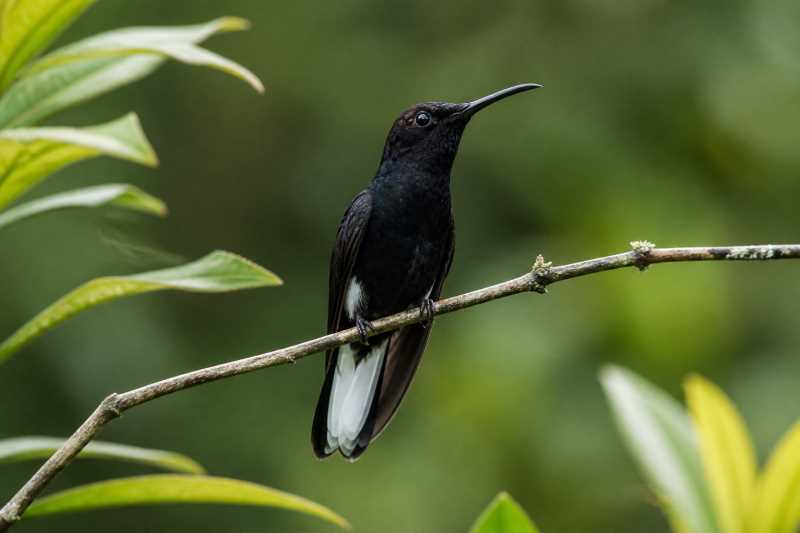
The Black Jacobin (Florisuga fusca) is a medium-sized hummingbird of South America. It is strongly associated with the Atlantic Forest region, but also occurs in other woodland, semi-open habitats, gardens and plantations. Its mainly black plumage, contrasting white flanks and strikingly patterned tail make it one of the more distinctive hummingbirds in its range.
Physical Description
The Black Jacobin measures approximately 12 to 13 centimetres in length. Adults of both sexes are broadly similar, with mostly black plumage, a bronzy-olive back and rump, and white flanks. The central tail feathers are black, while the outer tail feathers are largely white with dark tips. The straight bill is black.
The plumage can show subtle greenish or bluish reflections in strong light, but the species is best recognised by its black body and sharply contrasting white sides and tail. Unlike many hummingbirds, it does not show strong adult sexual dimorphism.
Juveniles are darker and less sharply marked than adults. They may show a broad cinnamon-brown band across the throat, a paler belly and more extensive dark colouring in the tail.
Range and Habitat
The Black Jacobin occurs mainly in eastern and south-eastern Brazil, from Bahia south to Rio Grande do Sul, with additional records in eastern Uruguay, south-eastern Paraguay and north-eastern Argentina. Its principal range includes the Atlantic Forest and adjoining regions.
It uses humid forest, forest edges, woodland clearings, secondary growth, gardens and plantations containing flowering trees or shrubs. The species can occur from near sea level to approximately 1,400 metres, although local abundance varies with habitat and season.
The Black Jacobin is not a strictly sedentary species. Seasonal movements have been recorded, including a general tendency for southward movement during the austral winter, but the full pattern is not well understood. Some winter records also come from inland areas of south-central Brazil.
Where to See This Species
Parque Estadual dos Três Picos, Rio de Janeiro, Brazil
The Black Jacobin is documented in the bird inventory for Parque Estadual dos Três Picos, where it has been recorded in Atlantic Forest habitats and associated clearings. The park is a realistic place to search for the species, particularly around flowering vegetation and forest-edge areas.
Nearby accommodation: Cachoeiras de Macacu is the main practical gateway, with guest houses, small hotels and self-catering accommodation in the surrounding area.
Reserva Ecológica de Guapiaçu, Rio de Janeiro, Brazil
The Black Jacobin is listed as a common species at Reserva Ecológica de Guapiaçu, also known as REGUA. Its mosaic of restored wetlands, forest, woodland and open areas provides suitable feeding habitat, and the species has been recorded in several habitat types within the reserve.
Nearby accommodation: Cachoeiras de Macacu is the nearest established accommodation base, with guest houses, small hotels and nature-oriented lodges.
Parque Estadual de Vassununga, São Paulo, Brazil
The Black Jacobin is included in the official avifaunal inventory for Parque Estadual de Vassununga. The park protects remnants of native vegetation within a largely agricultural landscape, making its forest patches, edges and flowering plants useful places to look.
Nearby accommodation: Santa Rita do Passa Quatro is the nearest practical town for hotels, guest houses and self-catering accommodation.
Behaviour and Diet
Black Jacobins are active during daylight hours and usually forage alone. They hover at flowers, move quickly between feeding sites and may defend productive flowers or feeding territories from other hummingbirds and nectar-feeding birds.
Nectar forms the main part of the diet. The species visits flowers of native and cultivated trees, shrubs and bromeliads. It also takes small insects and spiders, which provide protein and other nutrients, especially during the breeding season.
The species may make short hovering displays while opening and closing its tail, producing a conspicuous fan-like flash of white. Breeding details are not fully documented across the entire range, but the female builds a small cup-shaped nest from plant material and spider silk, incubates the eggs and feeds the nestlings. The usual clutch is two eggs.
Identification Tips
- Look for a medium-sized hummingbird with an almost entirely black head, throat and underparts.
- Check for white flanks and a tail with black central feathers, white outer feathers and dark tips.
- The back and rump may appear bronzy or olive rather than pure black.
- The straight black bill helps separate it from hummingbirds with noticeably curved bills.
- Juveniles can look browner and less sharply patterned, with cinnamon colouring on the throat.
- In the Atlantic Forest, the combination of black plumage, white flanks and a boldly patterned tail is usually sufficient for identification.
Conservation Status
The Black Jacobin is currently assessed as Least Concern on the global IUCN Red List. This category indicates that it is not presently considered at immediate global risk of extinction, but it does not mean that local populations are secure.
Habitat loss and fragmentation remain important concerns, particularly in the Atlantic Forest. The species also depends on the continued availability of flowering plants and suitable nesting vegetation. Protecting forest remnants, restoring native vegetation and maintaining connected habitat can benefit the Black Jacobin and other nectar-feeding birds. More information is needed about its population trend and seasonal movements in different parts of its range.
Frequently Asked Questions
Where can the Black Jacobin be found?
The Black Jacobin is found mainly in eastern and south-eastern Brazil, with additional populations or records in eastern Uruguay, south-eastern Paraguay and north-eastern Argentina.
What does a Black Jacobin look like?
It is a 12 to 13 centimetre hummingbird with mostly black plumage, an olive or bronzy back, white flanks and a black-and-white tail. The bill is straight and black.
Is the Black Jacobin migratory?
It shows seasonal movements, including a general tendency for southward movement during the austral winter. The complete migration pattern is not yet well understood, and movement varies across the range.
What does the Black Jacobin eat?
Its main food is nectar from flowering trees, shrubs and bromeliads. It also catches small insects and spiders.
Where is the best place to see a Black Jacobin?
Protected Atlantic Forest sites such as Parque Estadual dos Três Picos and Reserva Ecológica de Guapiaçu in Rio de Janeiro, or Parque Estadual de Vassununga in São Paulo, offer documented opportunities. Look around forest edges, clearings and flowering plants.
References
- BirdLife International
- Birds of the World, Cornell Lab of Ornithology
- IOC World Bird List
Related posts