Introduction
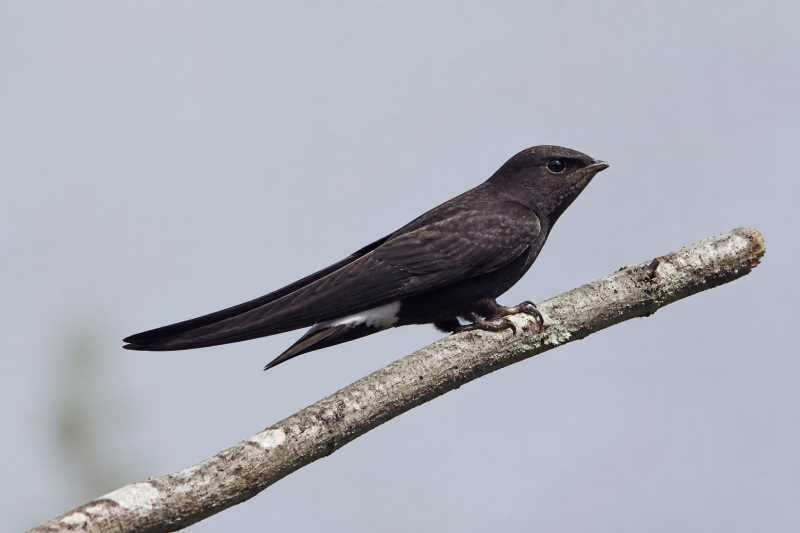
The Purple Needletail (Hirundapus celebensis) is a large swift in the family Apodidae. It is native mainly to the Philippines and the Minahasa region of northern Sulawesi, Indonesia. Usually encountered in fast, purposeful flight above forest and open country, it is a resident or largely non-migratory species rather than a long-distance migrant. (datazone.birdlife.org)
Physical Description
The Purple Needletail is a powerful, broad-bodied swift measuring about 25 centimetres in length. Reported adult weights are approximately 170–203 grams, making it one of the largest swifts. (oiseaux.net)
Its plumage is predominantly glossy black with a purple, blue or green sheen in suitable light. The forehead and lores are pale, while the lower flanks and undertail-coverts show white markings. The rump and back can appear browner or more sooty than the wings and tail. Its long, pointed wings, heavy body and short, spiny tail are characteristic of a needletail adapted for fast aerial movement. (repository.si.edu)
Males and females are not known to show obvious differences in the field. Age-related variation is poorly documented, although immature birds may appear duller than fully mature adults.
Range and Habitat
The species occurs across much of the Philippine archipelago, with records from islands including Luzon, Mindoro, Negros, Tablas and Mindanao. It also occurs in northern Sulawesi, particularly the Minahasa region. Current range summaries generally exclude Palawan. (birdguides.io)
Purple Needletails use a broad range of landscapes, including lowland and montane forest, forest edges, clearings and open areas above wooded terrain. They are often detected overhead rather than inside dense vegetation, where they use rising air and open flight paths while searching for insects. The species is generally regarded as resident or non-migratory, although local movements and seasonal changes in detectability may occur. (oiseaux.net)
Where to See This Species
Mount Makiling Forest Reserve, Laguna, Philippines
Purple Needetail has been recorded around Mount Makiling, including the forested areas near Los Baños. The reserve’s mature woodland, open clearings and elevated slopes provide suitable conditions for watching large swifts overhead. Sightings are most likely during active daylight periods when birds are feeding above the forest canopy. (inaturalist.org)
Nearby accommodation: Los Baños is the practical gateway, with hotels, guest houses, university-area accommodation and other self-catering options.
Tangkoko Nature Reserve, North Sulawesi, Indonesia
Tangkoko is a publicly accessible protected forest and an established wildlife-viewing destination in northern Sulawesi. Purple Needletails have been recorded in the wider Tangkoko area, where forest margins and open airspace provide opportunities for overhead sightings. (club300.se)
Nearby accommodation: Bitung is the main gateway, with guest houses, small hotels and nature-tourism accommodation serving visitors to the reserve.
Lore Lindu National Park, Central Sulawesi, Indonesia
Purple Needletails have been recorded within Lore Lindu National Park. The park’s extensive forest, mountain valleys and open areas around forested landscapes offer suitable habitat for observing fast-flying swifts, particularly during clear daytime weather. (club300.se)
Nearby accommodation: Palu is the principal service centre for access to the park, while smaller settlements such as Wuasa provide more local guest-house and homestay accommodation for some approaches.
Behaviour and Diet
Purple Needletails spend much of their active time in the air. They fly with rapid, powerful wingbeats interspersed with glides and may form loose groups while feeding. Their large size, deep wingbeats and direct flight usually distinguish them from smaller swiftlets.
The species is insectivorous and takes flying invertebrates in the air. Its diet may include beetles, ants, bees and other aerial insects, although detailed species-specific dietary studies are limited. Swift species commonly forage where flying insects are concentrated by forest edges, rising air and weather conditions. (oiseaux.net)
Breeding behaviour remains poorly documented. Nest sites are likely to be difficult to access, and reliable information on nest construction, clutch size and parental care is limited. Claims that the species routinely builds saliva-bound nests should therefore be treated cautiously unless supported by direct field evidence.
Identification Tips
- Look for a very large, heavy-bodied swift with long pointed wings and a short, spiny tail.
- The overall colour is glossy black or purplish-black, often showing an iridescent sheen in sunlight.
- Pale markings on the forehead and lores, together with white on the lower flanks and undertail-coverts, are useful at close range.
- The flight is strong and direct, with powerful wingbeats and occasional glides above forest or open country.
- White-throated Needletail (Hirundapus caudacutus) can occur in the same broad region, but it is identified by its contrasting white throat and collar and is generally associated with migratory movements. Brown-backed Needletail (Hirundapus giganteus) is another potential comparison, but its browner upperparts and different range should help separate it where both species are considered.
- Identification from a distant silhouette can be difficult, so photographs or repeated views are useful, especially when separating large needletails from other swifts.
Conservation Status
The Purple Needletail is currently assessed as Least Concern. Available assessments do not provide a reliable global population estimate or establish a clearly documented population trend. (datazone.birdlife.org)
Forest loss, logging, agricultural conversion and habitat fragmentation may affect the species locally by reducing suitable forest landscapes and potentially limiting nesting or roosting sites. Protecting remaining forest, maintaining connected habitats and improving knowledge of the species’ breeding ecology are appropriate conservation priorities. The current Least Concern assessment should not be interpreted as evidence that local populations are secure everywhere.
Frequently Asked Questions
Where is the Purple Needletail found?
It is found mainly in the Philippines and in northern Sulawesi, Indonesia, especially the Minahasa region. It is associated with forested landscapes and open airspace above them.
Is the Purple Needletail a migratory bird?
It is generally regarded as resident or non-migratory. Local movements may occur, and seasonal variation in sightings does not necessarily indicate long-distance migration.
How large is the Purple Needletail?
Adults are about 25 centimetres long and may weigh approximately 170–203 grams. It is one of the largest members of the swift family.
What does the Purple Needletail eat?
It feeds on flying insects and other aerial invertebrates caught during flight, including insects such as beetles, ants and bees.
How can the Purple Needletail be identified in flight?
Look for a very large, dark swift with long pointed wings, a short spiny tail and powerful direct flight. Pale facial markings and white on the lower flanks or undertail may be visible in good light.
Is the Purple Needletail endangered?
No. It is currently classified as Least Concern, although habitat loss and forest fragmentation may create local pressures and the species’ breeding biology remains insufficiently known.
References
- BirdLife International
- IUCN Red List of Threatened Species
- IOC World Bird List
Related posts