Introduction
The Blue-billed Duck, Oxyura australis, is a small Australian stiff-tailed duck and a member of the family Anatidae. Endemic to Australia, it occurs mainly in deep, permanent wetlands in the south-east and south-west of the continent. The species is almost wholly aquatic and is best known for the male’s bright blue breeding-season bill, compact body and distinctive stiff tail.
Physical Description
The Blue-billed Duck measures approximately 35–44 centimetres in length. It has a compact body, a short neck, a large head, a broad scooped bill and pointed, spine-like tail feathers characteristic of stiff-tailed ducks.
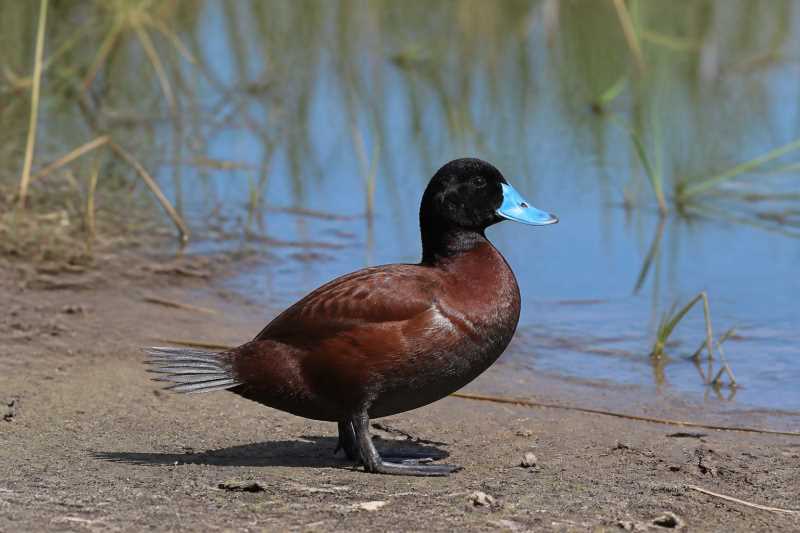
Breeding males are particularly striking. They have a glossy black head and upper neck, rich chestnut plumage on the body and wings, and a bright blue bill. The tail is dark and is usually held flat on the water, although it may be raised during courtship or when the bird is alarmed.
Females are more subdued, with dark brown to brownish-black plumage marked by fine, lighter barring and mottling. Their bill is dark grey-green or brown rather than bright blue. Outside the breeding season, some males become duller and may resemble females, although certain males retain much of their breeding plumage. Young birds are also generally less distinctive than adult breeding males.
Range and Habitat
The Blue-billed Duck is endemic to Australia. Its range includes temperate wetlands in south-eastern and south-western Australia, with important concentrations in the Murray–Darling Basin and other areas of inland and coastal southern Australia.
It prefers deep, permanent freshwater wetlands, swamps, lakes and dams with dense aquatic vegetation. Breeding sites commonly contain cumbungi or bullrushes, Typha species, lignum, sedges or spikerushes. The species is seldom seen on land and normally swims low in the water, often close to cover.
Blue-billed Ducks are partly migratory or seasonally nomadic. Young birds may disperse from inland breeding swamps to larger lakes, river systems and coastal wetlands, particularly during the non-breeding season. Experienced breeding birds may remain relatively sedentary. In New South Wales, birds may move between breeding swamps and non-breeding wetlands over distances of up to approximately 300 kilometres.
Behaviour and Diet
The Blue-billed Duck is secretive and difficult to observe, especially when breeding. When approached, it often dives rather than flies. Birds may occur alone or in small groups during the breeding season, while non-breeding flocks can gather on large, open lakes and dams, sometimes numbering several hundred individuals.
Feeding takes place at the water’s surface and underwater. The species dives to obtain aquatic insects and their larvae, including midges, caddisflies, dragonflies, flies and water beetles. It also eats plant material such as seeds, buds, stems, leaves and fruit. Feeding is often concentrated in the early morning and late afternoon.
Breeding generally occurs from late winter through summer, with timing varying between regions. Nests are usually built over deep water in dense vegetation, particularly cumbungi beds. They may be constructed from dead Typha leaves and lined with down, or formed as bowl-shaped nests in trampled wetland vegetation. The usual clutch contains four to six eggs, most commonly five or six. Incubation lasts about 26–28 days, and the male does not take part in nest-building or incubation. Pair bonds are short-lived, and the species is polygamous.
Courtship includes head movements, bill movements, diving and tail-raising displays. The male may produce a low rattling sound, while the female’s call is described as a soft, low quack.
Identification Tips
- Look for a compact diving duck sitting low in the water, often near dense aquatic vegetation.
- A breeding male has a vivid blue, broad, scooped bill, a dark glossy head and neck, and rich chestnut body plumage.
- Females, immature birds and non-breeding males are darker and browner, with fine pale barring and a dull grey-green or brown bill.
- The stiff, pointed tail is often held flat on the water but may be raised vertically during display or when alarmed.
- The species commonly dives when disturbed, rather than immediately flying.
- The Musk Duck, Biziura lobata, is the most relevant comparison. It is generally larger and has a heavier bill; male Musk Ducks also develop a conspicuous fleshy lobe beneath the bill. Female and non-breeding Blue-billed Ducks can otherwise appear similar at a distance.
Conservation Status
The Blue-billed Duck is assessed globally as Near Threatened on the IUCN Red List. In Australia, its conservation status varies between jurisdictions. It is listed as Vulnerable in New South Wales and is not listed under the Australian Environment Protection and Biodiversity Conservation Act according to the cited New South Wales species profile.
The principal threats are the loss and degradation of wetlands, including drainage, altered river flows, water extraction, flood mitigation works, clearing, overgrazing and the degradation of dense nesting vegetation. Salinity, agricultural chemicals, rubbish, invasive weeds, frequent burning, disturbance, illegal hunting and predation by introduced foxes, pigs and cats can also affect the species.
Climate-driven changes in rainfall, flooding and wetland persistence may intensify these pressures, particularly where permanent deep water and dense aquatic vegetation are already limited. Conservation measures include protecting and restoring wetlands, maintaining ecologically appropriate water flows, managing salinity and nutrient pollution, limiting heavy grazing and burning in breeding habitat, controlling weeds and monitoring populations and movements. Recording sightings also helps improve knowledge of distribution and population trends.
Frequently Asked Questions
Where does the Blue-billed Duck live?
The species is found only in Australia, mainly in temperate wetlands across the south-east and south-west, including the Murray–Darling Basin. It favours deep, permanent wetlands with dense aquatic vegetation.
Why is the male’s bill blue?
The adult male’s bill becomes bright blue during the breeding season. Outside that period, some males develop a duller bill and less contrasting plumage.
What does the Blue-billed Duck eat?
It eats aquatic insects and their larvae, as well as seeds, buds, stems, leaves and fruit from aquatic plants. It feeds both at the surface and by diving.
Does the Blue-billed Duck migrate?
It is partly migratory and seasonally nomadic rather than a long-distance migrant. Young birds may move between inland breeding swamps and non-breeding lakes, rivers and coastal wetlands.
How does the Blue-billed Duck breed?
It usually nests alone in dense wetland vegetation over deep water. The female generally lays four to six eggs and incubates them for about 26–28 days. The male does not incubate the eggs.
Is the Blue-billed Duck threatened?
Globally, it is classified as Near Threatened. Wetland drainage, altered water regimes, loss of nesting vegetation, salinity, pollution, disturbance and introduced predators are among the main conservation concerns.
References
- BirdLife International. 2022. Oxyura australis. The IUCN Red List of Threatened Species 2022: e.T22679827A210733513. https://www.iucnredlist.org/species/22679827/210733513 (accessed 8 September 2026).
- BirdLife International. n.d. Blue-billed Duck Oxyura australis Species Factsheet. BirdLife DataZone. https://datazone.birdlife.org/species/factsheet/blue-billed-duck-oxyura-australis (accessed 8 September 2026).
- Australian Museum. 2024. Blue-billed Duck. Australian Museum, Sydney. https://australian.museum/learn/animals/birds/blue-billed-duck/ (accessed 8 September 2026).
- New South Wales Department of Climate Change, Energy, the Environment and Water. 2022. Blue-billed Duck, Oxyura australis, profile. NSW Threatened Species. https://threatenedspecies.bionet.nsw.gov.au/profile?id=10580 (accessed 8 September 2026).
- Marchant, S. and Higgins, P. J., eds. 1990. Handbook of Australian, New Zealand and Antarctic Birds. Volume 1: Ratites to Ducks, Part B: Australian Pelican to Duck. Oxford University Press, Melbourne.
- Frith, H. J. 1977. Waterfowl in Australia. Angus and Robertson, Sydney.
- Gill, F., Donsker, D. and Rasmussen, P., eds. 2026. IOC World Bird List, version 15.2. International Ornithologists’ Union. https://www.worldbirdnames.org/ (accessed 8 September 2026).
Related posts