Introduction
The Grey Teal, Anas gracilis, is a small dabbling duck of the Australasian region. It is widespread in Australia and New Zealand and is especially well adapted to wetlands that vary in water level and permanence. Unlike many migratory waterfowl, Grey Teals are largely nomadic within their range, moving in response to rainfall, flooding and the availability of suitable feeding and breeding habitat.
Physical Description
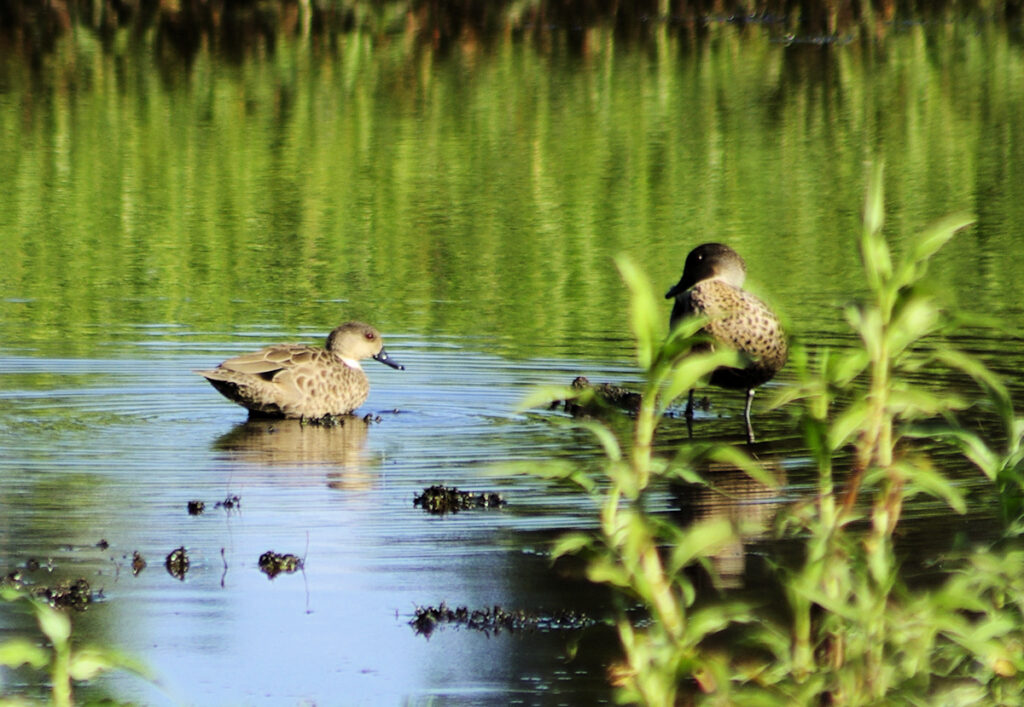
The Grey Teal is a compact duck measuring approximately 37–48 cm in length. Its plumage is generally grey-brown to dark brown, with pale edges to many body feathers that create a softly scaled appearance. The head is darker than the body, while the chin, throat and sides of the face are noticeably pale, often appearing whitish.
Both sexes are similar in appearance, although males are generally slightly larger. Adults have reddish-brown eyes, a dark grey bill and grey legs. In flight, the wing shows a glossy dark speculum with a greenish or bluish sheen and a contrasting pale or white area. Juveniles are similar to adults but tend to have duller, less clearly defined plumage.
Range and Habitat
The Grey Teal occurs throughout much of Australia, including Tasmania, and is also established in New Zealand. Individuals may disperse to nearby islands and parts of New Guinea and the south-western Pacific, particularly when favourable wetland conditions develop.
It uses a wide range of wetlands, including freshwater lakes, rivers, creeks, billabongs, swamps, floodplains, irrigation areas, estuaries, saltmarshes and sheltered coastal waters. It often favours shallow water with emergent or fringing vegetation, but can also occur on open water and temporary wetlands.
The species is not a strictly seasonal migrant. Instead, it makes irregular and sometimes extensive movements in response to rainfall and changing water conditions. Satellite-tracked birds in Australia have been recorded travelling hundreds of kilometres between wetlands after flooding or drying events.
Behaviour and Diet
Grey Teals usually feed by dabbling, tipping forward in shallow water or taking food from the water surface and wetland margins. They may also forage on exposed mudflats and on land near water. Their diet includes aquatic and terrestrial plant material, seeds, insects and their larvae, molluscs and small crustaceans. The balance of plant and animal food varies with season, habitat and local food availability.
The species may occur singly, in pairs, family groups or flocks. Larger gatherings are common when wetlands provide abundant food and safe roosting areas. Grey Teals can be active during both daylight and periods of low light, depending on local conditions.
Breeding is opportunistic and is closely associated with rainfall, rising water levels and adequate food. In southern Australia, breeding commonly occurs during the cooler months and spring, but nesting can take place at other times when conditions are favourable. Nests may be placed on the ground among vegetation, in hollows, in logs, in tree cavities near water or in other sheltered sites. The female usually lays about 4–14 eggs and incubates them for approximately 24–26 days. Ducklings are precocial, leaving the nest soon after hatching and feeding themselves under the protection of the female.
Identification Tips
- Look for a small, generally brown-grey duck with a distinctly pale throat and cheeks.
- The reddish-brown eye is conspicuous at close range.
- In flight, the dark glossy speculum and contrasting pale wing marking are useful features.
- The Grey Teal often sits high on the water and has a relatively compact profile.
- The female Grey Teal can resemble a female Chestnut Teal, Anas castanea. The Grey Teal usually has a paler, more extensive throat and face, while the female Chestnut Teal is generally darker and more strongly patterned. Identification can be difficult when birds are distant or poorly lit.
- The female has a distinctive rapid, laughing or descending series of calls. Males are generally quieter and give softer calls.
Conservation Status
The Grey Teal is classified as Least Concern on the IUCN Red List. Its broad distribution, ability to use both freshwater and saline wetlands, and capacity for rapid movement between suitable sites contribute to its generally secure global status.
Nevertheless, local populations can be affected by wetland drainage, loss of nesting vegetation, pollution, altered river flows, intensive water extraction, drought and other changes to wetland hydrology. Because the species depends on a network of permanent and temporary wetlands, conservation measures should include protection of wetland habitats, maintenance of environmental water flows, appropriate management of shallow feeding areas and continued monitoring of population movements and breeding success.
Frequently Asked Questions
Where does the Grey Teal live?
The Grey Teal is found mainly across Australia and New Zealand. It uses freshwater and saline wetlands, including rivers, lakes, swamps, floodplains, estuaries and sheltered coastal waters.
Is the Grey Teal migratory?
It is not a conventional long-distance seasonal migrant. Grey Teals are highly nomadic and may travel considerable distances in response to rainfall, flooding, drought and the availability of food and breeding habitat.
What does the Grey Teal eat?
Its diet includes aquatic plants, terrestrial vegetation, seeds, insects, insect larvae, molluscs and small crustaceans. The exact foods taken vary according to season and local conditions.
How can a Grey Teal be identified?
Key features include its small size, brown-grey plumage, pale throat and cheeks, reddish-brown eye, grey bill and dark glossy wing speculum. The pale throat is particularly useful when distinguishing it from a female Chestnut Teal.
Where does the Grey Teal nest?
Grey Teals may nest on the ground among vegetation, in logs, in tree hollows or in other sheltered sites close to water. Nest-site choice varies with habitat and local conditions.
Is the Grey Teal threatened?
The species is currently listed as Least Concern globally. Local threats remain, particularly the degradation, drainage and altered water management of wetlands, as well as drought and pollution.
References
- BirdLife International. 2026. Grey Teal Anas gracilis Species Factsheet. BirdLife DataZone. Available at: https://datazone.birdlife.org/species/factsheet/grey-teal-anas-gracilis (accessed 8 September 2026).
- Gill, F., Donsker, D. and Rasmussen, P. (eds). 2026. IOC World Bird List, version 15.2. International Ornithologists’ Union. Available at: https://www.worldbirdnames.org/ (accessed 8 September 2026).
- Museum Victoria. n.d. Anas gracilis, Grey Teal. Museums Victoria Collections. Available at: https://collections.museumsvictoria.com.au/species/8241 (accessed 8 September 2026).
- New South Wales Department of Climate Change, Energy, the Environment and Water. 2024. Birds in wetlands. NSW Government. Available at: https://www.environment.nsw.gov.au/topics/water/wetlands/plants-and-animals-in-wetlands/birds (accessed 8 September 2026).
- Department of Biodiversity, Conservation and Attractions, Western Australia. 2023. Grey Teal, Anas gracilis. Western Australian Government. Available at: https://library.dbca.wa.gov.au/static/FullTextFiles/060430.pdf (accessed 8 September 2026).
- Lavery, H. J. 1972. Studies of waterfowl (Anatidae) in north Queensland. 9. Grey teal (Anas gibberifrons gracilis Buller) at Saltwater habitat. Queensland Journal of Agricultural and Animal Sciences 29(3): 223–235. Available at: https://era.dpi.qld.gov.au/id/eprint/12073/ (accessed 8 September 2026).
- New Zealand Birds Online. n.d. Grey Teal, Anas gracilis. New Zealand Birds Online, Birds New Zealand, Department of Conservation and Te Papa. Available at: https://www.nzbirdsonline.org.nz/assets/95597/1691920149-023_grey-20teal.pdf (accessed 8 September 2026).
Related posts