Introduction
The Pacific Black Duck, Anas superciliosa, is a widespread dabbling duck native to Australia, New Zealand, New Guinea, Indonesia and many islands of the south-western Pacific. It occupies freshwater and coastal wetlands, including lakes, rivers, tidal mudflats, dams, reservoirs and urban parklands. In New Zealand it is also commonly known as the Grey Duck or pārera.
Physical Description
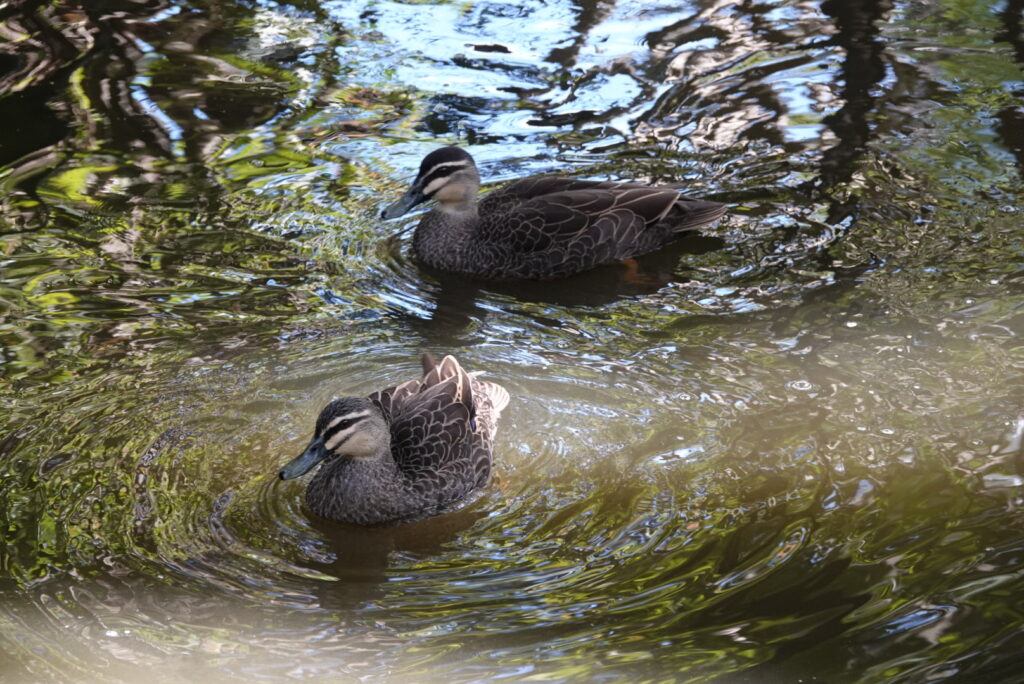
The Pacific Black Duck is a medium-sized, heavily built duck measuring approximately 47–60 centimetres in length. Its plumage is predominantly dark brown and finely mottled, providing effective camouflage in wetland vegetation. The head has a distinctive pattern of pale cream or buff stripes above and below the eye, separated by a dark stripe through the eye. The bill is generally grey, the iris is brown and the legs are usually olive-brown to greyish.
Both sexes are similar in appearance, although males are generally slightly larger. Juveniles resemble adults but may appear duller and less sharply marked. In flight, the greenish iridescent wing speculum and contrasting pale underwing can be visible. The species has no strongly contrasting male breeding plumage, which helps distinguish it from the familiar Mallard.
Range and Habitat
The Pacific Black Duck occurs across much of Australia, including Tasmania, and extends through New Guinea, Indonesia, New Zealand and numerous south-western Pacific islands. Its range reaches from the western Pacific, including Palau, eastwards to islands as far as the Austral Islands. Geographic variation has been described, particularly among island populations, but the treatment of some subspecies remains taxonomically variable.
It uses a broad range of wetland habitats, from forest pools, slow-flowing rivers and freshwater lakes to swamps, farm dams, reservoirs, tidal creeks, estuaries and coastal mudflats. It also occurs in modified environments such as urban lakes, public gardens and sewage-treatment wetlands. The species is generally sedentary or locally mobile rather than a long-distance migrant, although movements may occur in response to water availability and seasonal conditions.
Behaviour and Diet
Pacific Black Ducks are often seen singly, in pairs or in small groups, although larger flocks may form where food and shelter are concentrated. They rest on banks, floating vegetation, mudflats and low branches, and take flight readily when disturbed.
The species feeds mainly on plant material, including seeds and other parts of aquatic and waterside plants. Animal foods such as aquatic insects and their larvae, molluscs, snails and small crayfish are also taken. Feeding usually involves dabbling at the surface or upending in shallow water, with the duck tipping its body forward while reaching below the surface. Individuals may also feed on land in damp grass or mud.
Breeding can occur during different seasons across the broad range, depending on local rainfall, water levels and climate. Nests may be placed in tree hollows, old nests, on stumps or on the ground in dense vegetation near water. The female commonly lays about 7–12 eggs and undertakes most or all of the incubation, which lasts approximately 26–30 days. Ducklings are precocial and leave the nest soon after hatching, following the female to feeding areas. Pairs may remain together during the breeding period, but claims of permanent lifelong pair bonds are not universal across the species.
Identification Tips
- Look for the bold pale eyebrow and cheek markings, with a dark stripe running through the eye.
- The overall plumage is dark, mottled brown rather than the grey-bodied appearance of a typical adult male Mallard.
- The bill is usually grey, and the bird often appears more heavily marked on the head and face than other common dabbling ducks.
- In flight, note the green wing speculum and pale underwing.
- The sexes look broadly alike, unlike the strongly different male and female plumage of Mallards.
- Mallards and Pacific Black Ducks can hybridise where they occur together. Hybrids may show an intermediate mixture of facial markings, body colour and bill pattern, so some individuals cannot be identified confidently from appearance alone.
Conservation Status
The Pacific Black Duck is assessed globally as Least Concern. Its extensive range, broad habitat tolerance and large, widespread populations support this assessment, although detailed population estimates and trends are not available for all parts of its range.
Local populations can face wetland drainage, habitat degradation, pollution, disturbance and changes in water regimes. In New Zealand, hybridisation and introgression with introduced Mallards are important conservation concerns because they can reduce the genetic distinctiveness of Grey Duck populations. Conservation measures include protecting and restoring wetlands, maintaining suitable water regimes, monitoring populations and limiting the establishment or release of feral and domestic Mallards where native duck populations are vulnerable.
Frequently Asked Questions
What is the scientific name of the Pacific Black Duck?
The accepted scientific name is Anas superciliosa. The species is also known as the Grey Duck or pārera in New Zealand.
Where does the Pacific Black Duck live?
It occurs across Australia, New Zealand, New Guinea, Indonesia and many islands of the south-western Pacific. It uses freshwater wetlands, estuaries, tidal mudflats, rivers, dams, reservoirs and urban lakes.
What does the Pacific Black Duck eat?
Its diet consists mainly of aquatic and waterside plant material, including seeds. It also eats aquatic insects, larvae, snails, other molluscs and small crayfish.
How can a Pacific Black Duck be identified?
The most useful field mark is its dark head with a pale eyebrow and cheek stripe separated by a dark line through the eye. Its body is dark and mottled, and both sexes have broadly similar plumage.
Do Pacific Black Ducks migrate?
The species is generally sedentary or locally mobile rather than a long-distance migrant. Individuals may move between wetlands when rainfall, water levels or food availability change.
Are Pacific Black Ducks endangered?
The species is globally classified as Least Concern. However, some regional populations, particularly Grey Ducks in New Zealand, face significant local pressure from habitat change and hybridisation with introduced Mallards.
References
- Australian Museum. 2024. “Pacific Black Duck.” Australian Museum, updated 23 July 2024. Australian Museum species account. Accessed 8 September 2026.
- Museum Victoria. n.d. “Anas superciliosa, Pacific Black Duck.” Museums Victoria Collections. Museums Victoria species account. Accessed 8 September 2026.
- Gill, F., D. Donsker and P. Rasmussen, eds. 2026. IOC World Bird List, version 15.2. International Ornithologists’ Union. IOC World Bird List. Accessed 8 September 2026.
- Birds New Zealand. 2022. “Anseriformes: Swans, Geese and Ducks.” Checklist of the Birds of New Zealand. Birds New Zealand checklist. Accessed 8 September 2026.
- Williams, M. 2019. “Phenotypic variability within and between regional populations of Anas superciliosa (Anatidae).” Notornis 66(2): 64–73. Article PDF.
- Rhymer, J. M., M. J. Williams, R. T. Kingsford, M. J. Braun and others. 2004. “Implications of phylogeography and population genetics for subspecies taxonomy of Grey (Pacific Black) Duck Anas superciliosa and its conservation in New Zealand.” Pacific Conservation Biology 10(1): 57–66. https://doi.org/10.1071/PC040057.
- Rhymer, J. M., M. J. Williams and M. J. Braun. 1994. “Mitochondrial analysis of gene flow between New Zealand Mallards (Anas platyrhynchos) and Grey Ducks (Anas superciliosa).” The Auk 111(4): 970–978. Article PDF.
- Marchant, S. and P. J. Higgins, eds. 1990. Handbook of Australian, New Zealand and Antarctic Birds. Volume 1: Ratites to Ducks. Oxford University Press, Melbourne. Species account for Anas superciliosa.
Related posts