The Northern Jacana: An Intriguing Avian Marvel
The Northern Jacana (Jacana spinosa) is a captivating bird that graces the wetlands of Central and South America with its unique appearance and fascinating behavioral traits. Known for its strikingly elongated toes and claws, the Northern Jacana is perfectly adapted to its habitat, where it walks gracefully across floating vegetation. This article delves into the various aspects of the Northern Jacana, exploring its habitat, behavior, ecological significance, and conservation status.
Habitat and Distribution
The Northern Jacana is primarily found in freshwater wetlands, marshes, and ponds across Central America, including parts of Mexico, Belize, Costa Rica, Nicaragua, and Panama. Its range extends into northern South America, encompassing regions in Colombia and Venezuela. These wetlands, abundant with floating vegetation such as water lilies and lotus, provide an ideal environment for the Northern Jacana to thrive.
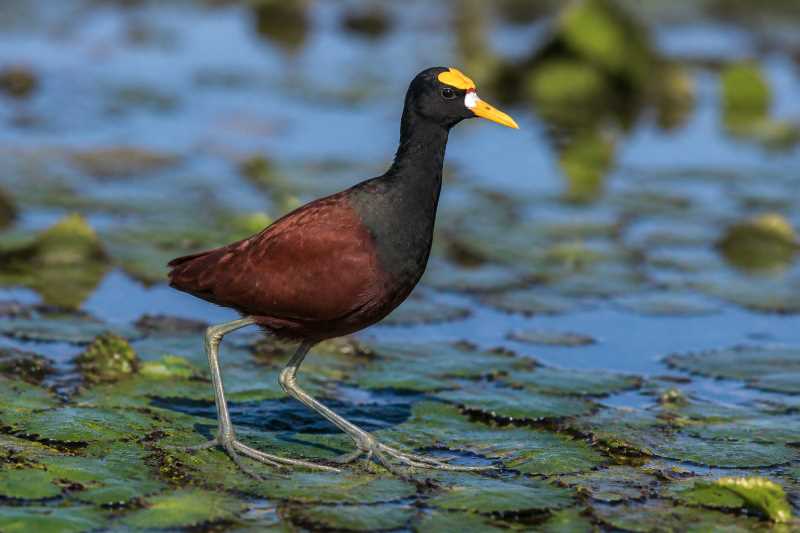
The bird’s ability to walk on floating vegetation is due to its oversized feet, which distribute its weight evenly, allowing it to tread lightly over lily pads and other aquatic plants. This adaptation not only aids in foraging but also provides a strategic advantage in avoiding predators.
Physical Characteristics
The Northern Jacana is a medium-sized bird, measuring approximately 23–31 centimeters in length, with a wingspan of about 50 centimeters. It is easily recognizable by its vibrant plumage; adults typically exhibit a rich chestnut-brown body contrasted against a striking yellow and black head and neck. The wings are primarily dark, with a hint of green iridescence under certain lighting conditions.
One of the most defining features of the Northern Jacana is its long, slender toes, which can be twice the length of its body. This adaptation is crucial for its lifestyle, as it allows the bird to distribute its weight over a large surface area, preventing it from sinking into the water as it moves across floating vegetation.
Behavior and Diet
Northern Jacanas are diurnal birds, most active during the day when they forage for food. Their diet primarily consists of insects, small invertebrates, and seeds. They use their sharp beaks to probe the surface of the water and vegetation, deftly picking out their prey.
The species exhibits a fascinating form of sexual dimorphism and role reversal in parenting. Females are larger and more dominant than males, and they engage in polyandrous mating systems. After laying eggs, the female leaves the responsibility of incubation and chick-rearing to the male, who diligently tends to the nest and young until they are independent.
Reproduction and Nesting
The breeding season for Northern Jacanas varies geographically, typically coinciding with the rainy season when food is abundant. The female lays a clutch of about four glossy, dark green to brown eggs, which are well camouflaged among the vegetation.
Nests are usually constructed on floating vegetation, providing stability and protection from ground-based predators. The male takes on the primary role of incubating the eggs, which hatch after approximately 22–28 days. The chicks are precocial, meaning they are relatively mature and mobile shortly after hatching.
Ecological Role and Conservation
Northern Jacanas play a vital ecological role in their habitats. By controlling insect populations and aiding in seed dispersal, they contribute to the health and balance of wetland ecosystems. Their presence also serves as an indicator of wetland health, as they thrive in environments that are rich in biodiversity and free from heavy pollution.
While the Northern Jacana is currently classified as a species of Least Concern by the International Union for Conservation of Nature (IUCN), its populations face threats from habitat destruction, pollution, and climate change. Wetland drainage for agriculture and development poses a significant threat, as it leads to the loss of crucial breeding and foraging grounds.
Conservation efforts are essential to ensure the survival of the Northern Jacana and the preservation of its habitat. Protecting wetland ecosystems through sustainable practices and environmental regulations can help mitigate the impact of human activities and climate change.
Conclusion
The Northern Jacana is a remarkable bird that captivates with its unique adaptations and intriguing behaviors. Its role in maintaining the ecological balance of wetland habitats underscores the importance of conserving these environments. As we continue to study and appreciate the Northern Jacana, it serves as a reminder of the intricate connections within ecosystems and the need to protect the natural world for future generations.
By understanding and valuing species like the Northern Jacana, we can foster a greater appreciation for biodiversity and the critical roles each organism plays in sustaining life on Earth.
Related posts