Introduction
The Coppery-tailed Coucal (Centropus cupreicaudus) is a large African coucal in the cuckoo family, Cuculidae. It is a secretive resident of wetlands and dense waterside vegetation in south-central Africa. Its deep, bubbling calls often reveal its presence before the bird emerges from reeds, papyrus or tangled riverine growth.
Physical Description
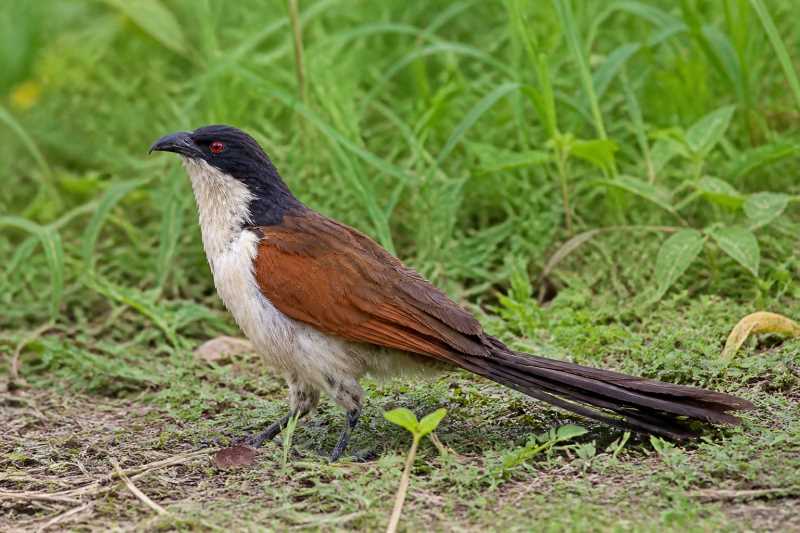
The Coppery-tailed Coucal is a large, heavy-bodied bird measuring approximately 42–50 centimetres in length. It has a deep, curved bill, strong legs and a long, broad tail.
Adults have a black forehead, crown, nape and mantle with a subtle violet or purple gloss. The wings are rich chestnut or reddish-brown, while the underparts are generally white to pale cream. The dark tail has a coppery sheen, particularly in good light, and the upper tail-coverts may show fine pale barring. The eyes are typically reddish in adults.
Young birds are duller and less glossy. They may show pale streaking on the head and darker barring on the wings and tail, making them less immediately distinctive than adults. Reliable evidence for consistent sex differences is limited, although males and females may differ slightly in size.
Range and Habitat
The Coppery-tailed Coucal occurs in a broad but discontinuous band across south-central Africa. Its range extends from Angola and north-eastern Namibia through northern Botswana and Zambia to parts of Malawi and south-western Tanzania. It is also associated with wetlands along the Chobe and Zambezi systems, including suitable areas near the borders of Zimbabwe and other neighbouring countries.
It favours dense wetland and waterside vegetation, including papyrus beds, reedbeds, tall grass, seasonally flooded floodplains, swamps, vleis and tangled riverine thickets. It may also occur beside seasonal lakes and in adjacent woodland where dense cover is available. Records extend from lowlands to approximately 1,250 metres.
The species is generally regarded as resident rather than migratory, although local movements may occur as water levels and vegetation conditions change.
Where to See This Species
Moremi Game Reserve, North-West District, Botswana
Moremi contains extensive permanent and seasonal wetlands, reedbeds and riverine vegetation within the Okavango Delta. The Coppery-tailed Coucal is included on bird lists for the reserve, and the species is most likely to be found where dense cover borders channels, lagoons and floodplain grasslands. Early morning and late afternoon are useful times to listen for its deep calls.
Nearby accommodation: Maun is the principal gateway, with lodges, guest houses, hotels, campsites and self-catering accommodation. Camps and lodges within or near the Okavango Delta provide closer access to suitable habitat.
Chobe National Park, North-West District, Botswana
The Coppery-tailed Coucal is documented in Chobe National Park, particularly in the wet habitats associated with the Chobe River and surrounding floodplain vegetation. Look for it in reedbeds, riverine thickets and tall grass, where it may move quietly through cover or call from concealed perches.
Nearby accommodation: Kasane is the main gateway and offers hotels, lodges, guest houses, campsites and self-catering accommodation.
Bwabwata National Park, Kavango East and Zambezi Regions, Namibia
Bwabwata includes floodplain, riverine and wetland habitats in the Kavango and Zambezi region, where the Coppery-tailed Coucal is documented among the park’s birdlife. Dense vegetation along waterways, seasonal wetlands and the Mahango area offer suitable places to search, especially during the wetter part of the year.
Nearby accommodation: Divundu is a practical gateway for the Mahango area, with lodges, riverside camps and campsites. Rundu provides a wider choice of hotels, guest houses and self-catering accommodation.
Behaviour and Diet
The Coppery-tailed Coucal is mainly active during the day, with increased activity soon after dawn and again late in the afternoon. It is territorial and usually keeps to dense vegetation, walking and climbing through reeds and tall grasses rather than making long flights.
Its diet is broad and opportunistic. Recorded prey includes grasshoppers, beetles and other large invertebrates, as well as frogs, fish, crabs, snails, lizards, small rodents and birds. It may raid the nests of weaverbirds and can scavenge dead fish or other edible material. Small amounts of plant food may also be taken.
The species is socially monogamous. Breeding is commonly reported from January to March, although timing may vary with rainfall and location. The nest is a bulky, loosely constructed structure made from grasses, reeds and twigs, usually placed low in dense vegetation and sometimes over water. Two to four eggs are laid. Both parents participate in incubation and care of the young, with the male possibly contributing the greater share of incubation and parental care. Young may leave the nest at about 17 days, sometimes before they are fully capable of sustained flight.
Identification Tips
- Look for a large, heavy coucal with a deep bill, long broad tail and powerful legs.
- Adults have a dark, subtly violet-glossed head and mantle, rich chestnut wings, pale underparts and a dark tail with a coppery sheen.
- The bird is usually found in dense reeds, papyrus, tall wetland grass or riverine thickets rather than in open grassland.
- Its deep, resonant bubbling call is often easier to detect than the bird itself.
- Compared with the Senegal Coucal, the Coppery-tailed Coucal is larger, heavier-billed and generally darker above, with a longer tail and more substantial proportions.
- Immatures are less glossy, with pale head streaking and more obvious barring on the wings and tail. Identification of young birds can therefore require attention to size, bill shape and habitat as well as plumage.
Conservation Status
The Coppery-tailed Coucal is currently assessed as Least Concern on the IUCN Red List. Its total population has not been reliably quantified, but the species has a broad range and is locally common in suitable wetland habitat. The overall population trend is not considered to be clearly declining.
Local threats may include the drainage, burning or conversion of wetlands, degradation of river margins, loss of dense waterside vegetation and changes to flooding patterns. Protecting floodplains, reedbeds, papyrus wetlands and riparian thickets is important for maintaining breeding and feeding habitat.
Frequently Asked Questions
Where can the Coppery-tailed Coucal be found?
It occurs in south-central Africa, from Angola and north-eastern Namibia through Botswana and Zambia to parts of Malawi and south-western Tanzania. It is associated mainly with wetlands and dense vegetation beside rivers and floodplains.
What does the Coppery-tailed Coucal look like?
It is a large coucal with a black, subtly violet-glossed head and mantle, chestnut wings, pale underparts and a long dark tail with a coppery sheen. It has a deep bill and strong legs.
What does the Coppery-tailed Coucal eat?
Its diet includes insects, frogs, fish, crabs, snails, lizards, small mammals and birds. It may also raid bird nests, scavenge carrion and take limited plant food.
Is the Coppery-tailed Coucal migratory?
It is generally considered a resident species. Local movements may occur when seasonal flooding, water levels or the availability of dense vegetation changes.
Where does the Coppery-tailed Coucal build its nest?
It builds a bulky grass and reed nest low in dense wetland vegetation, often among reeds or tangled waterside plants and sometimes above water.
What is the conservation status of the Coppery-tailed Coucal?
The species is assessed as Least Concern. It has a broad distribution, but local populations may be affected by wetland loss, river-margin degradation and changes to natural flooding patterns.
References
- BirdLife International
- IUCN Red List of Threatened Species
- IOC World Bird List
Related posts