Introduction
The Banner-tailed Kangaroo Rat (Dipodomys spectabilis) is a fascinating mammal belonging to the Heteromyidae family, primarily known for its unique adaptations to arid environments. This species is a quintessential example of how life thrives in seemingly inhospitable habitats, such as the deserts of the southwestern United States and northern Mexico. The Banner-tailed Kangaroo Rat is not just a marvel of evolutionary adaptation but also plays a crucial role in its ecosystem by participating in seed dispersion and serving as a prey species for numerous predators.
In this article, we delve into the intriguing world of the Banner-tailed Kangaroo Rat, exploring its physical characteristics, habitat preferences, behaviors, and the conservation challenges it faces. Whether you’re a wildlife enthusiast, a student, or a conservationist, this comprehensive guide will provide valuable insights into one of nature’s remarkable desert dwellers.
Physical Description
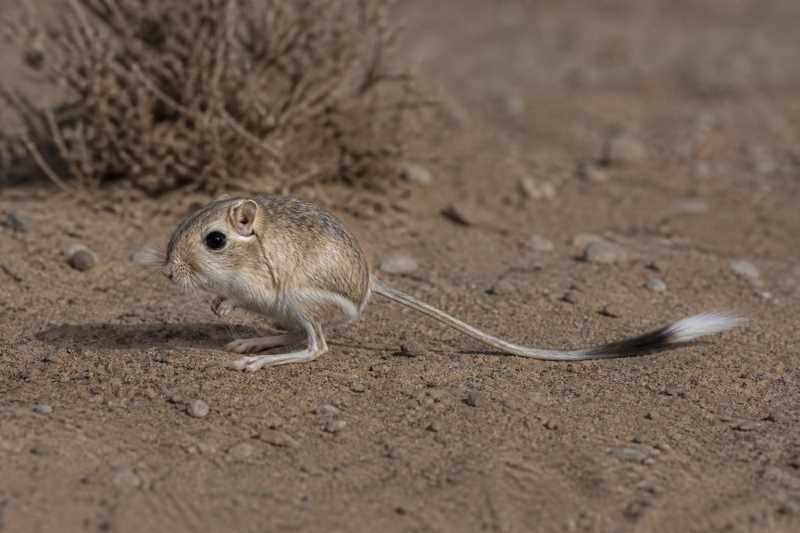
The Banner-tailed Kangaroo Rat is a medium-sized rodent, measuring about 13.5 to 15 inches (34 to 38 cm) in length, including its distinctive tail, which accounts for nearly 20 inches (51 cm). Weighing between 3.5 to 5 ounces (100 to 150 grams), it is characterized by its bipedal locomotion, hopping on its large hind legs similar to a kangaroo, hence its name.
The fur of the Banner-tailed Kangaroo Rat is generally a sandy brown or gray on the dorsal side, providing excellent camouflage against the desert floor. Its ventral side is typically white or pale. The species is named for its uniquely tufted tail that ends in a black-and-white banner-like tip, used for balance and communication.
Notably, the Banner-tailed Kangaroo Rat possesses large eyes and ears, adaptations that enhance its nocturnal lifestyle by improving its night vision and hearing. Its cheek pouches are fur-lined and used for carrying food, predominantly seeds, back to its burrow.
Range and Habitat
The geographic range of the Banner-tailed Kangaroo Rat extends across the deserts of the southwestern United States, including Arizona, New Mexico, and Texas, and into the northern regions of Mexico, particularly in the Chihuahuan Desert. This range is characterized by arid and semi-arid climates with sparse vegetation, primarily consisting of grasses and shrubs.
These kangaroo rats are typically found in open desert habitats with loose, sandy soils, which are favorable for burrowing. They prefer flat to gently sloping terrain and are often associated with mesquite and creosote bush communities. The availability of seed-producing vegetation greatly influences their habitat selection, as seeds constitute the bulk of their diet.
Behavior and Diet
As a nocturnal forager, the Banner-tailed Kangaroo Rat is primarily active during the night, which helps it avoid the extreme daytime temperatures of the desert. This nocturnal activity is complemented by its solitary nature, with individuals maintaining extensive burrow systems that provide shelter and food storage.
The diet of the Banner-tailed Kangaroo Rat is predominantly granivorous, consisting mainly of seeds from various desert plants, including grasses, mesquite, and creosote bushes. It is known for its remarkable ability to survive without direct water intake, deriving moisture from the seeds it consumes. This adaptation is critical for survival in its arid environment.
The species exhibits food caching behavior, where it collects and stores seeds in its burrow for later consumption. This not only ensures a continuous food supply during scarce periods but also contributes to seed dispersal and plant propagation across the desert landscape.
Identification Tips (Field Recognition Cues)
Identifying the Banner-tailed Kangaroo Rat in the field involves observing several key characteristics:
- Tail: Look for the distinctive tufted tail with a black-and-white pattern, which is a signature feature of this species.
- Hind Limbs: Note the large, powerful hind legs that facilitate their bipedal hopping movement, similar to that of a kangaroo.
- Size and Coloration: Observe the medium size (13.5 to 15 inches, including tail) and the sandy brown or gray coloration on the dorsal side with a white underside.
- Nocturnal Activity: They are active during nighttime, so sightings are more likely after dusk.
- Habitat: Check for their presence in desert habitats with sandy soils and sparse vegetation.
Conservation Status (with Threats and Protections)
The Banner-tailed Kangaroo Rat is currently listed as a species of "Least Concern" on the IUCN Red List. However, it faces several threats that could impact its population and habitat in the future. These threats include habitat destruction due to urban development, agricultural expansion, and climate change, which alters the desert ecosystems critical for their survival.
In response to these threats, various conservation measures are in place. Protected areas within its range help safeguard essential habitats, and ongoing research aims to better understand its ecological role and adaptive strategies. Public education and awareness campaigns also play a role in promoting conservation efforts for this species.
Frequently Asked Questions
1. What do Banner-tailed Kangaroo Rats eat? Banner-tailed Kangaroo Rats primarily eat seeds from desert plants such as grasses, mesquite, and creosote bushes. Their diet is highly adapted to their arid environment.
2. How do Banner-tailed Kangaroo Rats survive without water? These kangaroo rats obtain moisture from the seeds they consume, allowing them to survive without direct water intake, an essential adaptation for desert life.
3. Where can I find Banner-tailed Kangaroo Rats? They inhabit the deserts of the southwestern United States and northern Mexico, particularly thriving in open desert habitats with sandy soils.
4. Why are they called ‘Banner-tailed’? The species is named for its tail, which features a distinctive black-and-white tuft resembling a banner, used for balance and communication.
5. Are Banner-tailed Kangaroo Rats endangered? Currently, they are not considered endangered and are listed as "Least Concern." However, habitat destruction and climate change pose potential threats to their populations.
Related posts