Introduction
The Hamadryas Baboon, scientifically known as Papio hamadryas, is a fascinating Old World monkey species that holds a significant place in both the animal kingdom and human culture. Recognized for their unique social structures and striking physical appearance, Hamadryas Baboons have been subjects of interest for researchers and wildlife enthusiasts alike. This species is not only intriguing due to its behaviors and adaptations but also holds religious and historical significance, particularly in ancient Egyptian culture.
Hamadryas Baboons are part of the Cercopithecidae family and are closely related to other baboon species. However, they stand out due to their distinct sexual dimorphism and complex social systems. This article delves into the various aspects of Hamadryas Baboons, including their physical characteristics, habitat, behavioral patterns, conservation status, and more.
Physical Description
Hamadryas Baboons exhibit a pronounced sexual dimorphism, meaning there are significant differences in size and appearance between males and females. Male Hamadryas Baboons are notably larger, weighing between 20 to 30 kilograms (44 to 66 pounds), while females are considerably smaller, weighing between 10 to 15 kilograms (22 to 33 pounds).
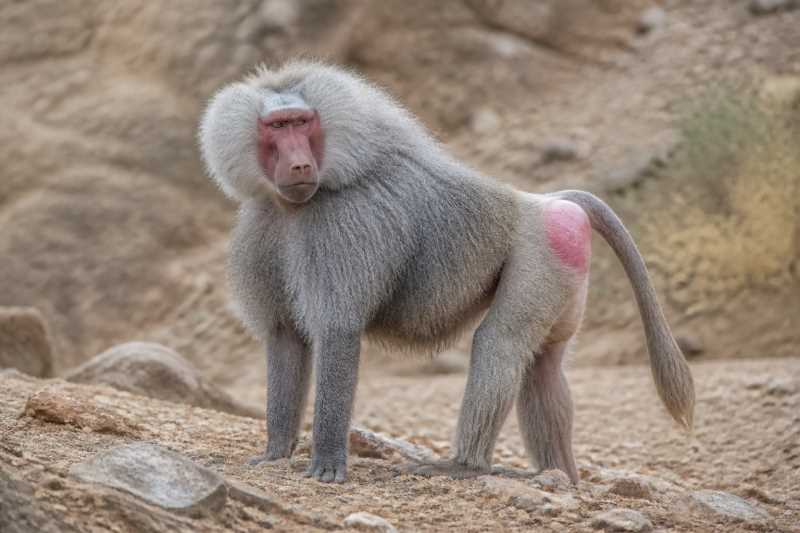
One of the most striking features of the male Hamadryas Baboon is their impressive mane. This thick, silver-grey fur covers their shoulders and neck, giving them a regal appearance. In contrast, females have shorter, brown fur and lack the distinctive mane. Both sexes have ischial callosities, which are the tough skin patches on their buttocks, aiding in comfortable sitting on rough surfaces.
The face of a Hamadryas Baboon is characterized by its pronounced muzzle and sharp canines, which are more prominent in males. They have large, expressive eyes and a pinkish-red face devoid of fur. Their tails are relatively short and end with a small tuft of hair.
Range and Habitat
Hamadryas Baboons are found predominantly in the Horn of Africa and the southwestern parts of the Arabian Peninsula. Their range includes countries like Ethiopia, Eritrea, Djibouti, Somalia, and Yemen. They are well-adapted to live in arid and semi-arid environments, often inhabiting rocky areas, savannas, and grasslands.
These baboons prefer habitats that offer both access to water and rocky cliffs or outcrops, which serve as sleeping sites. The rugged terrain provides them with protection from predators and a vantage point to survey their surroundings. Despite their preference for arid landscapes, Hamadryas Baboons are highly adaptable and can survive in a variety of environmental conditions as long as there is adequate food and water.
Behavior and Diet
Hamadryas Baboons are renowned for their complex social structure, which is organized into a multi-tiered system. The basic unit of their society is the one-male unit (OMU), consisting of a dominant male, several females, and their offspring. Multiple OMUs form a clan, and several clans come together to form bands. Occasionally, bands congregate into troops for activities like foraging or protection.
The dominant male in each OMU plays a crucial role in maintaining order, protecting the group, and managing conflicts. Females within an OMU have a clear hierarchy, often based on age and reproductive status. Grooming is a vital social activity, strengthening bonds and reducing tension within the group.
The diet of Hamadryas Baboons is omnivorous, consisting of fruits, seeds, leaves, flowers, roots, and insects. They are opportunistic feeders and have been known to eat small vertebrates when the opportunity arises. Their foraging behavior is highly adaptable, allowing them to exploit a wide range of food sources depending on seasonal availability.
Identification Tips (Field Recognition Cues)
Identifying a Hamadryas Baboon in the wild can be straightforward if you know what to look for:
- Mane and Body Size: Look for the large, silver-grey mane in males and the significant size difference between males and females.
- Facial Features: Note the pink, hairless face and the prominent muzzle.
- Behavior: Observe their social interactions, particularly the protective behavior of males and grooming activities among group members.
- Habitat: They are often found in rocky terrains with sparse vegetation, so spotting them in such environments increases your chances of identification.
Conservation Status (With Threats and Protections)
The International Union for Conservation of Nature (IUCN) currently lists the Hamadryas Baboon as a species of Least Concern. However, this status does not mean they are free from threats. Key threats to their population include habitat loss due to agricultural expansion, human-wildlife conflict, and hunting for bushmeat or traditional medicine.
In some regions, Hamadryas Baboons are also captured for the illegal pet trade. Moreover, their close proximity to human settlements often leads to conflicts, particularly when they raid crops or livestock.
Conservation efforts for Hamadryas Baboons focus on habitat preservation and conflict mitigation. Protected areas in their native range help safeguard their natural habitats, while community-based conservation programs aim to reduce human-baboon conflicts by promoting coexistence strategies.
Frequently Asked Questions
1. What is the social structure of Hamadryas Baboons?
Hamadryas Baboons have a unique multi-tiered social structure. It starts with the one-male unit (OMU), which includes a dominant male, several females, and their young. Multiple OMUs form a clan, several clans make up a band, and sometimes bands gather to form troops.
2. How do Hamadryas Baboons adapt to their environment?
These baboons are highly adaptable, living in arid and semi-arid environments with access to water sources and rocky shelters. Their omnivorous diet allows them to exploit various food resources, making them resilient to environmental changes.
3. Are Hamadryas Baboons endangered?
Currently, Hamadryas Baboons are not considered endangered and are listed as Least Concern by the IUCN. However, they face threats from habitat loss, hunting, and human conflict, necessitating ongoing conservation efforts.
4. What do Hamadryas Baboons eat?
Their diet is omnivorous, consisting of fruits, seeds, leaves, and insects. They are adaptable foragers, adjusting their diet based on seasonal availability and environmental conditions.
5. How can Hamadryas Baboons be distinguished from other baboon species?
Hamadryas Baboons can be distinguished by the males’ silver-grey mane, their pink, hairless faces, and their unique social structures, which differ from the more common multi-male, multi-female groups seen in other baboon species.
Related posts