Introduction
The Himalayan Snowcock, Tetraogallus himalayensis, is a large ground-dwelling member of the pheasant family, Phasianidae. It inhabits high mountain landscapes across Central and South Asia, where it is associated with alpine meadows, rocky slopes and open terrain above or near the tree line. The species is resident, although it may move to lower elevations seasonally, particularly when snow restricts access to food. (datazone.birdlife.org)
Physical Description
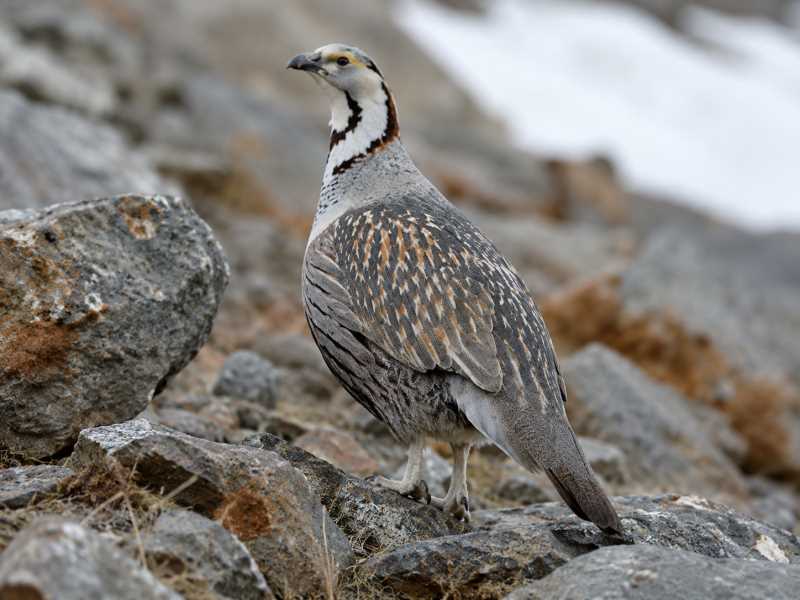
The Himalayan Snowcock is a robust, heavy-bodied bird measuring approximately 64–74 cm in length, with a wingspan of about 1.1–1.3 m. Its plumage is predominantly grey, with a white throat and pale facial areas bordered by chestnut markings. The upperparts are grey with rufous-edged feathers, while the breast and flanks show darker barring and streaking in black, chestnut and white. The undertail coverts are white, and the legs are yellow. (ndow.org)
The sexes are similar in colour and pattern. Males are generally larger and have a prominent tarsal spur, which is reduced or absent in females. Juveniles are duller and less crisply marked than adults, although age-related plumage details can vary across the species’ geographical range. (en.wikipedia.org)
Range and Habitat
The species occurs from Afghanistan and Pakistan eastwards through northern India and Nepal to western and northern China. It also occupies mountain systems of Central Asia, including parts of the Pamir, Tien Shan and related ranges. Populations have been introduced to the Ruby Mountains and East Humboldt Range of Nevada, United States, where the species has established locally. (avibase.bsc-eoc.org)
Himalayan Snowcocks favour open alpine and subalpine habitats, including grassy mountain slopes, alpine meadows, cold deserts, scree and rocky ridges. They are usually found at high elevations, commonly from roughly 3,600 m to more than 5,000 m during the warmer months, but may descend when heavy snowfall limits feeding opportunities. They generally avoid dense forest. (snr.unl.edu)
Several geographical forms and subspecies have been described across the extensive range. Plumage and body size may vary regionally, but the species remains taxonomically recognised as Tetraogallus himalayensis in the IOC World Bird List. (ww.worldbirdnames.org)
Behaviour and Diet
Himalayan Snowcocks are mainly terrestrial and spend much of their time walking or running across slopes while foraging. They are wary birds that often remain inconspicuous among rocks and vegetation. When disturbed, they may run uphill before taking flight, then use their powerful wings to cross valleys or move between ridges. Outside the breeding season, they are commonly seen in small groups, sometimes forming larger flocks. (snr.unl.edu)
The diet is chiefly plant-based. Recorded foods include grasses, shoots, leaves, roots, tubers, berries, forbs and seeds. Feeding activity is often concentrated during the morning and again later in the day, with birds resting during the warmer middle part of the day in some regions. (ndow.org)
The species has a loud, far-carrying whistle and other calls that help birds maintain contact across open, rugged terrain. During courtship, the male may crouch, spread his wings slightly, depress his tail and move around the female while calling. Breeding generally takes place from spring into summer, depending on local conditions. (snr.unl.edu)
The nest is a shallow scrape on the ground, usually sheltered by a rock, bush or clump of vegetation and often positioned where it is protected from prevailing winds. A typical clutch contains four to six eggs, although larger clutches have been reported. The female alone incubates the eggs for approximately 27–31 days, while the male may remain nearby and act as a lookout. The chicks are precocial and leave the nest soon after hatching, being tended by both parents while feeding for themselves. (ndow.org)
Identification Tips
Look for a very large, grey alpine gamebird with the following combination of features:
- A bulky body and short, rounded tail.
- A white throat and pale face framed by chestnut or reddish-brown markings.
- Grey upperparts with darker barring on the breast and flanks.
- White undertail coverts, often visible when the bird raises or cocks its tail.
- Yellow legs and a powerful, broad-winged flight.
- A habit of running uphill before flushing from a ridge or slope.
In flight, the contrasting white and dark patterning on the wings, together with rufous tones in the outer tail, can be useful. The Himalayan Snowcock may overlap geographically with the smaller Tibetan Snowcock, Tetraogallus tibetanus. The Himalayan Snowcock is generally larger and has a different head and wing pattern, so careful attention to overall size, facial markings and the pattern of the folded and open wing is important. (en.wikipedia.org)
Conservation Status
The Himalayan Snowcock is classified as Least Concern on the IUCN Red List. Its broad distribution and apparently substantial population mean that it is not currently considered globally threatened, although reliable population estimates and regional trend data are limited. In India, available regional monitoring has reported insufficient data to calculate a dependable long-term or annual population trend. (birdsoftheworld.org)
Potential pressures include habitat alteration in alpine and subalpine areas, disturbance from infrastructure and other development, excessive livestock grazing, hunting in some parts of the range, and climate-driven changes in snow cover and high-elevation vegetation. The species benefits from the protection of mountain habitats, effective regulation of hunting, maintenance of alpine grasslands and continued monitoring of populations across its range. These pressures should be assessed locally because their importance varies between countries and mountain systems.
Frequently Asked Questions
Where does the Himalayan Snowcock live?
It lives in high mountain regions from Afghanistan and Pakistan through northern India and Nepal to western and northern China, as well as parts of Central Asia. An introduced population also occurs in Nevada, United States.
How high does the Himalayan Snowcock live?
It commonly occupies elevations of roughly 3,600–5,000 m or more during the warmer months. It may move lower in winter or after heavy snowfall, but it generally remains in open mountain habitats rather than entering dense forest.
What does the Himalayan Snowcock eat?
Its diet consists mainly of plant material, including grasses, shoots, leaves, roots, tubers, berries, forbs and seeds.
How many eggs does a Himalayan Snowcock lay?
A usual clutch contains four to six eggs, although larger clutches have been recorded. The female incubates the eggs for approximately 27–31 days.
Can Himalayan Snowcocks fly?
Yes. They are primarily ground-dwelling, but they can make strong, rapid flights across valleys and between mountain ridges. When disturbed, they often run uphill before taking off.
Is the Himalayan Snowcock endangered?
No. The species is currently assessed as Least Concern globally. Nevertheless, local populations may be affected by habitat disturbance, hunting, grazing pressure and environmental change, and regional monitoring remains important.
References
- BirdLife International. n.d. Himalayan Snowcock Tetraogallus himalayensis species factsheet. BirdLife DataZone. Accessed 8 September 2026. https://datazone.birdlife.org/species/factsheet/himalayan-snowcock-tetraogallus-himalayensis
- Christensen, G. C. 2020. Himalayan Snowcock Tetraogallus himalayensis, version 1.0. In S. M. Billerman, editor, Birds of the World. Cornell Lab of Ornithology, Ithaca, New York. https://doi.org/10.2173/bow.himsno.01
- Gill, F., Donsker, D. and Rasmussen, P., editors. 2026. IOC World Bird List, version 15.2. International Ornithologists’ Committee. Accessed 8 September 2026. https://www.worldbirdnames.org/
- Nevada Department of Wildlife. n.d. Himalayan Snowcock. Accessed 8 September 2026. https://www.ndow.org/species/himalayan-snowcock/
- State of India’s Birds. 2023. State of India’s Birds factsheet: Himalayan Snowcock Tetraogallus himalayensis. Accessed 8 September 2026. https://stateofindiasbirds.in/species/2023/ul-himsno/
- University of Nebraska–Lincoln, School of Natural Resources. n.d. Himalayan Snowcock. Game Birds of the World, Madson Bird Collection. Accessed 8 September 2026. https://snr.unl.edu/data/appliedecology/madsonbird/individualbird.aspx?bid=70
- Zhao, Q., et al. 2019. Comparative phylogeography of two sister species of snowcock: impacts of species-specific altitude preference and life history. Avian Research 10: 27. https://doi.org/10.1186/s40657-019-0187-0
Related posts