Introduction
The Trinidad Piping Guan (Pipile pipile), known locally as the Pawi, is a forest bird endemic to the island of Trinidad. It belongs to the Cracidae family, which also includes chachalacas, guans and curassows. The species has declined greatly because of hunting and habitat loss and is currently classified as Critically Endangered.
Physical Description
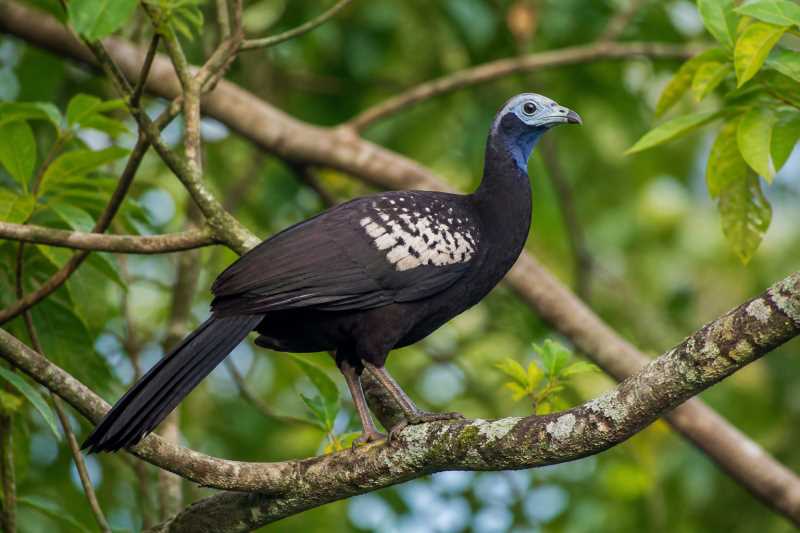
The Trinidad Piping Guan is a large cracid, reaching approximately 65 cm in length. It has predominantly blackish-brown plumage with a subtle purplish or bluish gloss. The large crest is dark and edged with white, while the wings have conspicuous white patches and extensive white tips to the wing-coverts.
The bare skin of the face and the wattle are blue, and the legs are reddish. The species has a distinctive, somewhat rounded outline when perched, with the raised crest and contrasting white wing markings providing useful field characters. Reliable information on sexual dimorphism and age-related plumage differences is limited.
Range and Habitat
The Trinidad Piping Guan is endemic to Trinidad and is not naturally found on Tobago or elsewhere. It formerly occurred more widely across the island, including parts of the Northern Range, the southern Trinity Hills and some lowland areas. It has since disappeared from much of this former range, including several lowland sites, and the population is now concentrated mainly in the eastern Northern Range.
The species inhabits remote lower and upper montane rainforest, particularly steep and hilly areas with streams, a closed canopy, abundant lianas and epiphytes, and relatively sparse ground cover. Most records are from approximately 400–900 metres above sea level, although it has also been recorded at lower elevations, including around 50 metres. It may occur in secondary vegetation and cultivated land close to primary forest, but it remains strongly associated with forested landscapes.
Behaviour and Diet
The Trinidad Piping Guan is primarily arboreal and spends much of its time in the forest canopy. It is usually encountered alone, in pairs or in small groups. Observational studies found that it is most active and visible during the early morning and late afternoon, while it may remain quiet and difficult to observe around midday.
Its diet consists mainly of fruit, with leaves, flowers and developing fruits taken occasionally. Recorded food plants include Virola surinamensis and ornamental nutmeg, Myristica fragrans. The birds have also been observed drinking water from epiphytes, including bromeliads. As a large frugivore, the Pawi may contribute to the dispersal of large forest seeds.
The species produces plaintive whistles, softer piping calls and a mechanical wing-drumming or rattling sound made during display. Courtship may involve bowing, turning, vocalising, wing displays and tail fanning. Breeding information remains limited, but observations indicate that the breeding season may be extended rather than restricted to a short, fixed period. The nest is a shallow platform in a tree or tree fern, and the female alone has been observed incubating two or three large white eggs.
Identification Tips
Look for a large, dark forest bird with the following combination of features:
- A blackish-brown body with a faint purplish or bluish sheen.
- A prominent dark crest edged with white.
- Large white patches on the wings and broad white markings on the wing-coverts.
- Blue bare facial skin and a blue wattle.
- Reddish legs.
- A thin piping call or, during display, a rattling wing sound.
The species is most likely to be confused with other large cracids at a distance, but its combination of a dark plumage, white wing markings, blue facial skin and conspicuous crest is distinctive in Trinidad. Care is needed because the bird often remains concealed in dense canopy and may be detected by its calls before it is seen.
Conservation Status
The Trinidad Piping Guan is classified as Critically Endangered on the IUCN Red List. Available assessments describe a decreasing population and a very restricted remaining range. An older national estimate placed the wild population at approximately 70–200 individuals, but this figure should not be treated as a current census without a more recent population assessment.
The principal threats are illegal hunting and the loss, degradation and fragmentation of forest through timber extraction, agricultural conversion and other forms of human encroachment. The species has been legally protected in Trinidad since 1963 and is listed in Appendix I of CITES. Much of its remaining habitat lies within forest reserves, state forests or protected areas, including the Matura area, but effective enforcement remains important.
Priority conservation measures include protecting and restoring remaining forest, preventing hunting, strengthening enforcement, monitoring known populations, surveying historically occupied sites, and improving knowledge of movements, breeding biology and habitat requirements. Public education and carefully managed nature tourism can also support local stewardship, provided that disturbance to the birds and their habitat is minimised.
Frequently Asked Questions
Where is the Trinidad Piping Guan found?
It is found only on the island of Trinidad, where the remaining population is concentrated mainly in forested areas of the eastern Northern Range.
Why is the Trinidad Piping Guan called the Pawi?
Pawi is the local name commonly used for the species in Trinidad. The English name refers to its distribution in Trinidad and its characteristic piping calls.
What does the Trinidad Piping Guan eat?
Its diet consists mainly of fruit. It also takes occasional leaves, flowers and developing fruits and has been observed drinking water from epiphytic bromeliads.
How can the Pawi be identified?
It is a large, dark forest bird with a white-edged crest, conspicuous white wing markings, blue facial skin and a blue wattle. Its piping whistles and rattling wing-drumming sound can also help with identification.
How many Trinidad Piping Guans remain in the wild?
An older assessment estimated approximately 70–200 individuals, but the population is decreasing and the estimate should not be regarded as a current census. The species remains Critically Endangered.
What is being done to protect the species?
Protection includes legal safeguards against hunting, conservation of forest reserves and national parks, population monitoring, ecological research, public education and efforts to improve enforcement and habitat protection.
References
- BirdLife International. 2026. Trinidad Piping-guan Pipile pipile Species Factsheet. BirdLife DataZone. Accessed 8 September 2026. https://datazone.birdlife.org/species/factsheet/trinidad-piping-guan-pipile-pipile
- Gill, F., Donsker, D. and Rasmussen, P., eds. 2026. IOC World Bird List, version 15.2. International Ornithologists’ Union. Accessed 8 September 2026. https://www.worldbirdnames.org/
- Environmental Management Authority, Trinidad and Tobago. n.d. Trinidad Piping-guan (Pawi). Trinidad Biodiversity. Accessed 8 September 2026. https://www.biodiversity.gov.tt/index.php/protected-areas-and-species/environmentally-sensitive-species-ess/trinidad-piping-guan-pawi.html
- Hayes, F. E., Shameerudeen, C. L., Sanasie, B., Hayes, B. D., Ramjohn, C. L. and Lucas, F. B. 2009. “Ecology and behaviour of the critically endangered Trinidad piping-guan Aburria pipile.” Endangered Species Research 6(3): 223–229. https://doi.org/10.3354/esr00153
- Hayes, F. E., Sanasie, B. and Samad, I. 2009. “Status and conservation of the critically endangered Trinidad piping-guan Aburria pipile.” Endangered Species Research 7: 77–84. https://doi.org/10.3354/esr00184
- Naranjit, K. T. 2015. Phenology of the Trinidad Piping-guan, Pipile pipile. MPhil thesis, The University of the West Indies, St Augustine. https://uwispace.sta.uwi.edu/bitstreams/adcaa268-4f14-4594-bbfb-4e6d9c7cfc3c/download
- Rostant, L. 2019. “Insights into the Reproductive Ecology of the Critically Endangered Trinidad Piping-Guan, Pipile pipile Revealed Through Camera Trapping.” Living World, Journal of the Trinidad and Tobago Field Naturalists’ Club. https://ttfnc.org/livingworld/index.php/lwj/article/view/a5
- BirdLife International. 1992. “Trinidad Piping-guan Pipile pipile.” In Threatened Birds of the Americas: The ICBP/IUCN Red Data Book, regional species account. BirdLife International archive. https://birdlifedata.blob.core.windows.net/red-data-books/Pipile_pipile_eng.pdf
Related posts