Introduction
The Turquoise-throated Puffleg (Eriocnemis godini), also known as Godin’s Puffleg, is an exceptionally poorly known hummingbird associated with northern Ecuador. It is known from only a small number of historical specimens, and no confirmed record exists from the twentieth or twenty-first century. The species is therefore treated as Critically Endangered, Possibly Extinct, although undiscovered individuals cannot be ruled out. (birdsoftheworld.org)
Physical Description
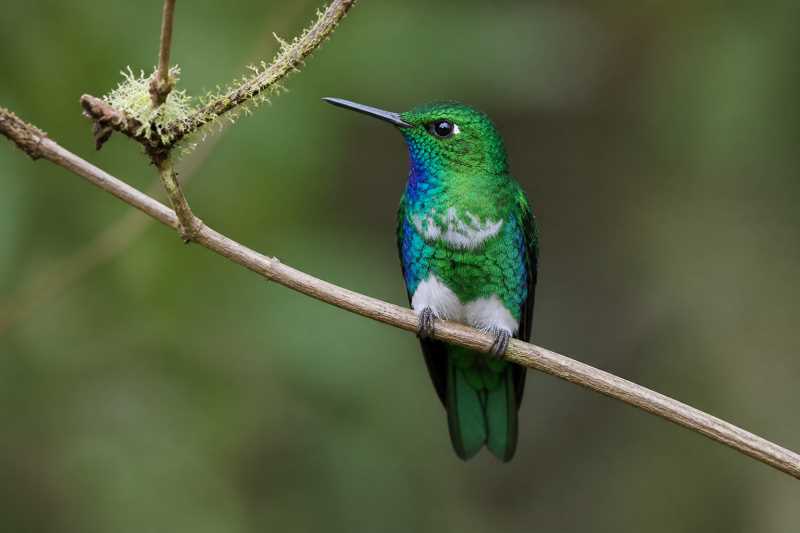
The Turquoise-throated Puffleg is a small hummingbird, but reliable measurements are limited. Historical specimens indicate a predominantly green bird with blue undertail coverts and conspicuous white, fluffy feather tufts around the legs, a characteristic feature of pufflegs.
The male has an iridescent bluish-purple or turquoise throat patch. The female is less brightly coloured, lacks the male’s iridescent throat patch and is described as having generally less glittering plumage with more golden tones on the underparts. Immature plumage has not been adequately documented. (birdsoftheworld.org)
Range and Habitat
The species is known primarily from northern Ecuador, especially the Guayllabamba drainage and nearby areas north-west of Quito. The type specimen was collected in 1850 at an elevation of approximately 2,100 to 2,300 metres.
The historical locality consisted of steep-sided, relatively dry ravines containing remnants of montane dry forest and scrub. Other potentially suitable remnants were reported around Pululahua and the Río Blanco area. Much of the original vegetation in this region has been cleared or heavily modified, leaving only scattered fragments.
Two nineteenth-century specimens labelled “Bogotá” have led to suggestions that the species may also have occurred in south-western Colombia, possibly near southern Nariño. Their precise provenance is uncertain, so Ecuador remains the only confirmed country of occurrence. The species is considered monotypic and is believed to be sedentary, although its movements are not known with confidence. (birdsoftheworld.org)
Where to See This Species
No public wildlife-viewing venue can currently be recommended with confidence for the Turquoise-throated Puffleg. The species has no confirmed modern population, and the historical sites associated with it do not provide a reliable opportunity for visitors to see it. Any future search would require carefully targeted ornithological surveys in remnant ravine habitat in northern Ecuador rather than ordinary birdwatching visits.
Behaviour and Diet
Very little is known about the species’ behaviour. As with other hummingbirds, it is presumed to have fed on flower nectar and possibly small arthropods, but its feeding ecology has not been documented adequately.
The species was probably sedentary, and there is no reliable evidence of regular migration. Historical information on breeding is extremely limited. A clutch of two white eggs and incubation by the female have been reported, but no detailed account of nesting behaviour is available. (birdsoftheworld.org)
Identification Tips
The combination of green plumage, blue undertail coverts, white leg puffs and a brilliant bluish-purple or turquoise throat patch would be distinctive in the male. The female would be more difficult to identify because it lacks the male’s iridescent throat marking.
The most important potential confusion species is the Glowing Puffleg (Eriocnemis vestita), which is reported to resemble the Turquoise-throated Puffleg closely. Careful attention should be paid to the throat colour, underparts, tail and the precise location of any observation. Because the Turquoise-throated Puffleg has no confirmed modern population, any claimed sighting would require strong documentation, including photographs, sound recordings or a detailed field description. (birdsoftheworld.org)
Conservation Status
The Turquoise-throated Puffleg is listed as Critically Endangered, Possibly Extinct, under the IUCN assessment category CR(PE). The classification reflects the absence of confirmed records for many decades, the very small known historical range and the extensive destruction of suitable habitat. (nc.iucnredlist.org)
The principal threats are habitat loss, vegetation clearance, fragmentation and continuing pressure on the dry montane ravines where the species was historically found. An unconfirmed sighting was reported from the Chillo Valley near Quito in 1976, but searches in 1980 and again during 2004 and 2005 failed to relocate the bird.
Conservation priorities include protecting remaining natural vegetation near the historical localities, surveying suitable ravines and clarifying whether any surviving population remains. Habitat protection would also benefit other species restricted to the fragmented montane environments of northern Ecuador. (birdsoftheworld.org)
Frequently Asked Questions
Where is the Turquoise-throated Puffleg found?
It is known from northern Ecuador, particularly the Guayllabamba drainage and nearby areas north-west of Quito. Possible occurrence in south-western Colombia is based on uncertain nineteenth-century specimen labels.
Is the Turquoise-throated Puffleg extinct?
It has not been confirmed extinct, but it is classified as Critically Endangered, Possibly Extinct. No confirmed modern record has established that a surviving population remains.
When was the Turquoise-throated Puffleg last confirmed?
The last confirmed evidence consists of nineteenth-century specimens. A sighting reported in 1976 was not confirmed, and later targeted searches were unsuccessful.
What does the Turquoise-throated Puffleg look like?
It is a small green hummingbird with blue undertail coverts and white feather puffs around the legs. The male has an iridescent bluish-purple or turquoise throat patch, while the female is duller and lacks that patch.
Can birdwatchers see this species in a reserve or national park?
No current public venue can be recommended as a reliable site for the species. Its historical range is uncertain, and there is no confirmed modern population accessible to birdwatchers.
What are the main threats to the species?
The main threats are the loss and fragmentation of dry montane forest and scrub, agricultural clearance and the degradation of the steep ravine habitats where the species was historically recorded.
References
- IUCN Red List of Threatened Species
- Cornell Lab of Ornithology, Birds of the World
- IOC World Bird List
Related posts