Introduction
The Sand Partridge, Ammoperdix heyi, is a small, resident partridge of arid and semi-arid regions in north-east Africa and the Middle East. It is associated mainly with rocky desert slopes, wadis and sparsely vegetated hillsides. Its sandy plumage, preference for cover and ability to obtain much of its moisture from food help it survive in hot, water-limited environments.
Physical Description
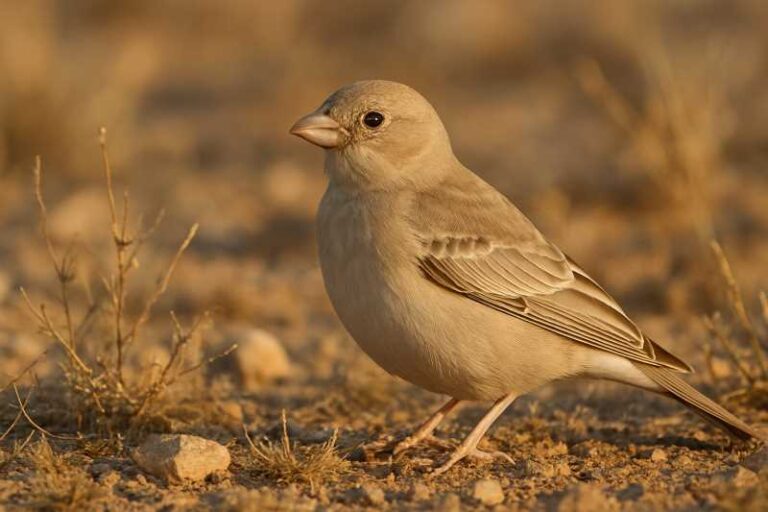
The Sand Partridge is a compact bird measuring approximately 22–25 cm in length and weighing about 180–200 g. It has a sandy-brown to buff body, a greyish head and finely barred or mottled upperparts. The flanks show distinctive wavy barring in chestnut, buff and black, while the outer tail feathers may appear reddish-brown when the bird moves or flies.
Males are more strongly marked than females. They usually have a grey head, a white spot on the ear-coverts and a rufous or chestnut throat. Females are duller, greyer and more uniformly sandy, with less conspicuous head markings. Juveniles generally resemble adult females and have a more subdued pattern.
Plumage varies geographically. Four subspecies are generally recognised in traditional treatments, with differences in colour intensity and in the size or presence of pale markings on the forehead and lores.
Range and Habitat
The Sand Partridge is a resident species rather than a long-distance migrant. Its range extends from Egypt, the Sinai Peninsula, Israel and Jordan through Saudi Arabia and the southern Arabian Peninsula to Yemen and Oman. Regional populations also occur in north-eastern Sudan. The species is largely restricted to the Middle East and adjacent north-east Africa.
It occupies dry, open country, including rocky or stony slopes, desert hills, boulder-strewn wadis and sandy wadi beds with scattered shrubs. In Saudi Arabia, habitat studies found a preference for flood banks and rocky wadi beds with moderate vegetation cover. The species may occur from below sea level in the Dead Sea region to around 2,000 m in suitable mountainous areas, although elevation varies across its range.
The Sand Partridge is not confined to completely barren ground. Scattered shrubs and other woody vegetation provide food, shade and shelter from predators. Local movements between rocky breeding areas and better-vegetated valleys may occur, but the species is generally considered sedentary.
Behaviour and Diet
Sand Partridges are ground-dwelling birds that often run uphill or into cover when disturbed rather than taking flight immediately. They are frequently encountered in pairs or small groups, with larger groups more likely outside the breeding season. Activity is greatest during the cooler part of the day, particularly in the early morning, although the precise daily pattern varies with temperature and habitat.
The diet is mixed and includes seeds, berries, green plant material, leaves and buds, together with insects. Seeds can form a substantial part of the diet, while berries and other moist plant foods may become important during hot periods. Insects provide an additional source of protein, particularly when available during the breeding season.
The species is adapted to limited water availability. Studies of Negev Desert partridges indicate that Sand Partridges have relatively low water requirements in relation to their food intake, helping them tolerate dry diets and extreme desert conditions. This does not mean that free water is unimportant, and suitable habitat is often associated with wadis or other places where food and occasional water are available.
Breeding generally takes place during spring, although timing varies geographically and may extend from late winter into summer. The nest is a shallow scrape on the ground, usually placed beneath a shrub, beside a rock or under an overhanging slab, and may be sparsely lined with local vegetation. Clutches commonly contain about five to seven eggs. The female normally incubates the eggs, and the chicks are precocial, leaving the nest soon after hatching and being capable of following the adults while foraging.
Identification Tips
Look for a small, rounded, sandy-coloured partridge on rocky desert slopes or in wadis. Useful field marks include:
- Overall sandy-brown or buff plumage and compact body shape.
- A greyish head in the male, with a conspicuous pale ear-coverts spot.
- A rufous or chestnut throat in the male.
- Strongly barred flanks with chestnut, buff and black tones.
- A tendency to run uphill or disappear into cover when approached.
- Small groups or pairs in dry, rocky terrain rather than open cultivated land.
The closely related See-see Partridge, Ammoperdix griseogularis, can be difficult to separate, especially when females or juveniles are involved. Male Sand Partridges generally show a rufous throat and lack the strong black head pattern typical of male See-see Partridges. Range is also useful: the two species occupy different principal regions, although introductions and possible contact in parts of Arabia complicate identification and distribution records.
Conservation Status
The Sand Partridge is currently classified as Least Concern on the IUCN Red List. It remains widespread and locally common, but regional populations may be declining where hunting pressure, habitat degradation and disturbance are significant. A regional assessment for the Arabian Peninsula identified declining numbers in some areas, especially outside protected areas, while noting that the estimated decline does not meet the threshold for a higher global category.
Important pressures include unsustainable hunting, degradation of rocky wadis and desert vegetation, disturbance from recreational activities and changes to water and grazing regimes. The introduction of closely related partridges may also create competition, disease risks or opportunities for hybridisation in parts of the native range.
Conservation measures should include protection of key desert and wadi habitats, enforcement of sustainable hunting regulations, monitoring of regional population trends and careful management of introduced gamebirds. Maintaining native shrubs and natural vegetation in wadis is also important because these areas provide food and shelter.
Frequently Asked Questions
Where does the Sand Partridge live?
It occurs in arid and semi-arid regions from Egypt and the Sinai Peninsula through Israel, Jordan and Saudi Arabia to Yemen and Oman, with additional populations in parts of Sudan.
Is the Sand Partridge migratory?
No. It is generally a resident species. Local movements between breeding slopes and more productive valleys may occur, particularly when food availability changes.
What does the Sand Partridge eat?
Its diet includes seeds, berries, leaves, buds and other plant material, supplemented by insects. The exact balance varies with season, rainfall and local vegetation.
How does the Sand Partridge survive in the desert?
It reduces water demands through a relatively efficient relationship between water intake and food consumption, feeds on moisture-containing plant foods when available and uses rocky terrain and vegetation for shelter from heat and predators.
Where does the Sand Partridge nest?
It nests on the ground, usually in a shallow scrape beneath a shrub, beside a rock or under an overhanging rock slab. The nest is often only lightly lined.
How can it be distinguished from the See-see Partridge?
Male Sand Partridges usually have a rufous throat and a less strongly black-patterned head. Females and juveniles are more difficult to separate, so location, habitat and careful examination of the head and flank pattern are useful.
References
- BirdLife International. 2016. Ammoperdix heyi. The IUCN Red List of Threatened Species 2016: e.T22678657A92783316. https://doi.org/10.2305/IUCN.UK.2016-3.RLTS.T22678657A92783316.en. Accessed 8 September 2026.
- Gill, F., Donsker, D. and Rasmussen, P. (eds). 2026. IOC World Bird List, version 15.2. International Ornithologists’ Union. https://www.worldbirdnames.org/ Accessed 8 September 2026.
- Kam, M., Degen, A. A. and Nagy, K. A. 1987. Responses of two Negev Desert phasianids, the chukar (Alectoris chukar) and the sand partridge (Ammoperdix heyi), to diets of different water content. Journal of Arid Environments 12(2): 169–174. https://doi.org/10.1016/S0140-1963(18)31187-X.
- Wronski, T. 2009. Habitat preference and diurnal activity pattern in the Sand Partridge, Ammoperdix heyi heyi (Aves: Phasianidae). Zoology in the Middle East 48(1): 35–42. https://doi.org/10.1080/09397140.2009.10638364.
- Ornithological Society of the Middle East, the Caucasus and Central Asia. 2020. Ornithological Regional List, part A: Non-passerines. OSME. https://www.osme.org/wp-content/uploads/2020/06/ORL-6.1-Part-A-Non-passerines.pdf. Accessed 8 September 2026.
- Naturalis Biodiversity Center. n.d. Bird Remains Identification System: Ammoperdix heyi, Sand Partridge. https://bris.linnaeus.naturalis.nl/linnaeus_ng/app/views/species/taxon.php?epi=147&id=112284. Accessed 8 September 2026.
Related posts