Introduction
The Mottled Spinetail (Telacanthura ussheri) is a small, fast-flying swift in the family Apodidae. It is distributed patchily across sub-Saharan Africa, where it is associated with forest edges, woodland, savanna, river corridors and other open areas near suitable insect prey. Its rapid flight and tendency to remain airborne can make it difficult to observe well.
Physical Description
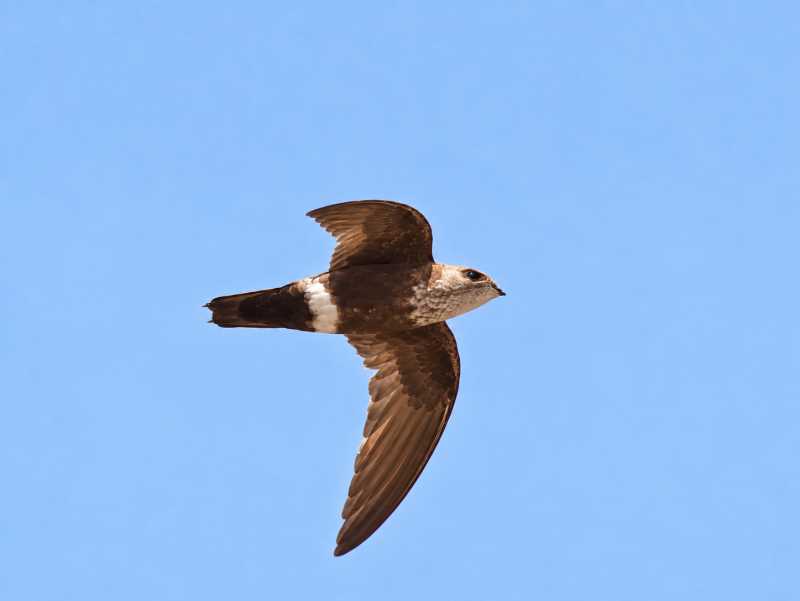
The Mottled Spinetail is a compact swift measuring about 14 cm in length. It has a streamlined body, long pointed wings and a short, square-ended tail whose stiff shafts give the species its common name, although the spines are rarely obvious in the field.
The plumage is generally dark brown, with extensive pale grey or whitish mottling on the chin and throat. A conspicuous white rump and pale lower-belly patch can create a contrasting pale band around the rear of the body. The wings and back are darker and more uniform than the underparts.
Males and females are not known to differ noticeably in plumage. Geographic variation occurs, with some eastern and central African forms appearing darker or less brown than birds from West Africa. Reliable age-related field differences are poorly documented.
Range and Habitat
The species has a broad but uneven distribution across sub-Saharan Africa. Its range extends from Senegal, The Gambia and Guinea-Bissau eastwards through West and Central Africa to Uganda, Kenya and Tanzania, and southwards through Angola, Zambia, Malawi, Mozambique, Zimbabwe and South Africa. The exact limits of the range vary between taxonomic and distributional treatments.
Mottled Spinetails use a variety of habitats, including humid lowland forest edges, gallery forest, wooded savanna, dry woodland, forest clearings, cultivated areas and settlements near suitable feeding habitat. They are often recorded over rivers, dams, roads and open country adjoining woodland or forest. The species is not restricted to intact rainforest.
The Mottled Spinetail is generally treated as resident or locally mobile, although seasonal movements and regional differences in occurrence are not fully understood. Several geographical forms are recognised, but their limits and significance may require further study.
Where to See This Species
Kakum National Park, Central Region, Ghana
Kakum is one of the most reliable documented sites for the species in Ghana. Mottled Spinetails have been recorded along forest roads and edges, including the Antwikwaa and Abrafo areas, where open flight paths beside mature forest provide suitable foraging habitat. They may be easier to detect in the early morning or during periods of increased insect activity.
Nearby accommodation: Cape Coast, Jukwa and the villages around Kakum offer guest houses, hotels, lodges and other visitor accommodation.
Kalakpa Resource Reserve, Volta Region, Ghana
The species has been recorded at Kalakpa, including around the Zitoe area and near water. The reserve’s mixture of woodland, forest patches, riverine habitat and open clearings provides suitable conditions for a swift that forages over both wooded and more open ground.
Nearby accommodation: Ho is the main practical gateway, with hotels, guest houses and self-catering accommodation available in and around the town.
Semliki National Park, Western Region, Uganda
Mottled Spinetail is included in biodiversity records for Semliki National Park. The park’s lowland forest, woodland margins, riverine areas and open clearings offer suitable habitat, although the species may be local and is likely to require patient scanning of the airspace above forest edges and waterways.
Nearby accommodation: Fort Portal and the Semliki corridor provide lodges, guest houses, camps and other accommodation used by visitors to the park.
Behaviour and Diet
Mottled Spinetails spend much of the day in flight, often travelling rapidly above forest edges, woodland, villages, rivers and clearings. They may appear singly or in small groups and can join other swifts when aerial insects are concentrated. Their flight includes fast wingbeats, sudden changes of direction and periods of gliding.
The species is insectivorous. It catches small flying insects in the air using its broad gape, with prey likely to include ants, termites, beetles, flies and other aerial insects. Feeding activity may increase around insect emergences, water, forest edges and clearings.
The species’ breeding biology remains poorly documented. Available information is insufficient to confirm a standard clutch size, breeding season or universally used nest site. Like other spiny-tailed swifts, it may use protected cavities or crevices, but detailed observations are needed before specific nesting claims can be treated as typical for the species.
Identification Tips
- Look for a small, dark swift with a short, square-ended tail and strongly pointed wings.
- The pale mottling on the chin and throat is distinctive at close range.
- A bright white rump and pale lower-belly patch are often the most useful features when the bird is seen from below.
- The bird’s rapid, twisting flight and frequent activity over forest edges or open woodland help separate it from slower-flying species.
- Do not rely on the tail spines alone. They are difficult to see unless the bird is close or photographed.
- The darker Black Spinetail (Telacanthura melanopygia) can occur in some of the same regions. Careful attention to the Mottled Spinetail’s pale rump, pale rear underparts and mottled throat is important when both species are present.
Conservation Status
The Mottled Spinetail is currently classified as Least Concern on the IUCN Red List. Its broad distribution means that it is not presently considered globally threatened, but its population size and detailed trend are not well quantified.
Habitat loss through deforestation, agricultural expansion, woodland clearance and urban development may affect local populations, particularly where forest edges, nesting sites and nearby feeding areas are lost together. Maintaining forest mosaics, river corridors, woodland and open foraging areas within protected landscapes can benefit the species. Further monitoring is needed because its aerial habits and patchy distribution make population assessment difficult.
Frequently Asked Questions
Where can the Mottled Spinetail be found?
It occurs patchily across sub-Saharan Africa, from West Africa through Central and East Africa and southwards into parts of southern Africa.
What does the Mottled Spinetail look like?
It is a small dark swift with pointed wings, a short spiny tail, pale mottling on the throat, a white rump and a pale patch on the lower belly.
What does the Mottled Spinetail eat?
It feeds on small flying insects captured in the air, including insects associated with forest edges, woodland, rivers, clearings and other productive feeding areas.
Is the Mottled Spinetail a migratory bird?
Its movements are not fully understood. It is generally regarded as resident or locally mobile, although seasonal movements may occur in parts of its range.
Where is the best place to see this species?
Kakum National Park and Kalakpa Resource Reserve in Ghana are well-documented sites. Semliki National Park in Uganda also has records, although sightings may require patient scanning of open airspace above forest and woodland margins.
Is the Mottled Spinetail threatened?
It is currently assessed as Least Concern. Local populations may nevertheless be affected by deforestation, woodland clearance and the loss of suitable nesting and feeding habitat.
References
- International Union for Conservation of Nature
- Cornell Lab of Ornithology, Birds of the World
- International Ornithologists’ Union, IOC World Bird List
Related posts