Introduction
The Green-tailed Emerald (Chlorostilbon alice) is a small hummingbird endemic to northern Venezuela. It inhabits forest edges, cloud forest, secondary growth and other semi-open habitats in the country’s northern mountain ranges. The species is recognised as a separate, monotypic species by several major bird taxonomies, although its limits in relation to the Short-tailed Emerald and Narrow-tailed Emerald remain taxonomically debated.
Physical Description
The Green-tailed Emerald is a very small hummingbird, measuring approximately 7.5–8.5 cm in males and 6.5–7.5 cm in females, with a mass of about 3–4 g. Both sexes have a short, straight, black bill.
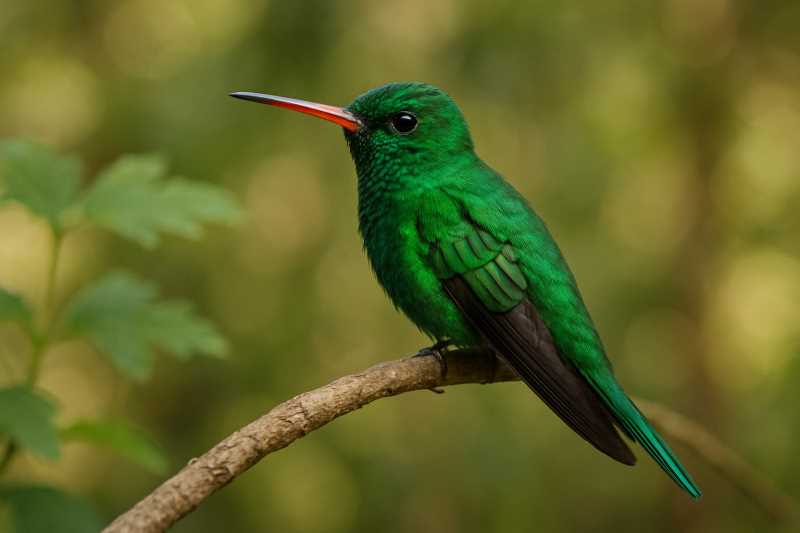
Males have a shining dark-green forehead and crown, bronzy-green upperparts, a glittering bronze-green tail and grass-green underparts. Females are more subdued. They retain the green upperparts but have a pale greyish underside, dark grey undertail coverts and a noticeable white line behind the eye. The central tail feathers are green, while the outer feathers have green bases, darker bands and greyish tips. Immature birds resemble females and may show buff-coloured feather edges around the head.
Range and Habitat
The Green-tailed Emerald is endemic to northern Venezuela. Its range extends through the mountainous regions from Falcón and Lara eastwards towards Sucre and northern Monagas.
It is a resident species rather than a migrant. It occurs mainly between about 700 and 1,800 metres above sea level, especially along the edges of humid lowland and montane forest, cloud forest, secondary woodland, plantations, gardens, parks and roadsides. It is generally associated with semi-open vegetation and is less often found in dense, undisturbed forest.
Where to See This Species
Henri Pittier National Park, Aragua and Carabobo, Venezuela
BirdLife International identifies Henri Pittier National Park as an important site for the Green-tailed Emerald. The park contains humid forest, cloud forest, riverine woodland and forest edges, and the species has been recorded as a resident in several of these habitats. Public access is associated with areas including Rancho Grande and the road through the Portachuelo pass, although sightings are not guaranteed.
Nearby accommodation: Maracay is the main practical gateway, with hotels and guest houses, while Choroní provides smaller inns, guest houses and self-catering accommodation on the park’s coastal side.
Waraira Repano National Park, Caracas and Miranda, Venezuela
Also known as El Ávila, Waraira Repano is listed by BirdLife International among the important sites for this species. Its range of elevations includes humid forest, forest edges and secondary habitats suitable for the Green-tailed Emerald. Accessible approaches from Caracas include established trails and recreation areas, but birdwatchers should check current access conditions before travelling.
Nearby accommodation: Caracas offers the widest choice of hotels, guest houses and serviced apartments. The mountain settlement of Galipán also has small inns and guest houses where available.
El Guácharo National Park, Monagas, Venezuela
El Guácharo National Park is another BirdLife International site identified for the Green-tailed Emerald. The protected area includes humid mountain forest and secondary vegetation within the Caripe range, matching the species’ documented habitat preferences. The park and its surrounding trails are publicly visited, although local guidance may be required for some routes.
Nearby accommodation: Caripe is the recognised gateway settlement, with hotels, guest houses, rural lodges and self-catering accommodation serving visitors to the park and the Cueva del Guácharo area.
Behaviour and Diet
The Green-tailed Emerald is active during daylight and usually forages alone. Like other emerald hummingbirds, it feeds primarily on nectar from flowering shrubs and small trees. Reported food plants include members of the legume, coffee, gesneriad and heath families. It may also take small insects, which provide additional protein.
Individuals may defend productive feeding areas from other hummingbirds and make rapid aerial chases when competing for flowers. The species is resident throughout its range and does not undertake regular long-distance migration.
The breeding season has been reported from January to March. Detailed information about nest construction, incubation and fledging is limited, so precise figures should be treated cautiously.
Identification Tips
- Look for a very small hummingbird with a short, straight, black bill.
- Adult males show a dark shining green forehead and crown, bronzy-green upperparts, grass-green underparts and a bronze-green tail.
- Females are paler below and show a conspicuous white line behind the eye.
- The green tail helps separate this species from hummingbirds with distinctly blue or strongly forked tails.
- The Short-tailed Emerald and Narrow-tailed Emerald are genuinely similar, and identification can be difficult where their ranges or taxonomic boundaries approach one another. Pay close attention to tail shape, tail colour, bill length and the bird’s geographic location.
- Brief views are common, so habitat and elevation can be useful supporting clues, particularly in northern Venezuelan mountain regions.
Conservation Status
The Green-tailed Emerald is currently assessed as Least Concern. BirdLife International reports a stable population trend, although the total number of mature individuals has not been quantified.
The species occurs in a relatively broad range and is recorded from numerous protected or otherwise important bird areas. Potential pressures include forest clearance, development, agricultural expansion and changes to flowering resources. Current conservation priorities include monitoring population trends, improving knowledge of population size and assessing possible threats across its range.
Frequently Asked Questions
Where is the Green-tailed Emerald found?
It is endemic to northern Venezuela, where it occurs in mountain regions from Falcón and Lara eastwards to Sucre and northern Monagas.
Is the Green-tailed Emerald a migratory bird?
No. It is regarded as a resident species and does not undertake regular long-distance migration.
What habitat does the Green-tailed Emerald use?
It favours forest edges, cloud forest, secondary growth, plantations, gardens, parks and roadsides, generally between about 700 and 1,800 metres above sea level.
What does the Green-tailed Emerald eat?
Its diet consists mainly of nectar from flowering shrubs and small trees. It also occasionally eats small insects.
How can the Green-tailed Emerald be identified?
The male has a shining green forehead and crown, bronzy-green upperparts, grass-green underparts and a greenish-bronze tail. Females are paler below and usually show a white line behind the eye.
Is the Green-tailed Emerald threatened?
It is currently listed as Least Concern. Its population is considered stable, but habitat loss and insufficient monitoring remain conservation concerns.
References
- BirdLife International
- Cornell Lab of Ornithology, Birds of the World
- IOC World Bird List
Related posts