Introduction
The Lucifer Sheartail, also known as the Lucifer Hummingbird, is a small hummingbird of arid and semi-arid habitats in Mexico and the south-western United States. Its scientific name is Calothorax lucifer. The species is especially recognisable for the male’s iridescent purple throat, long down-curved bill and narrow, deeply forked tail.
Physical Description
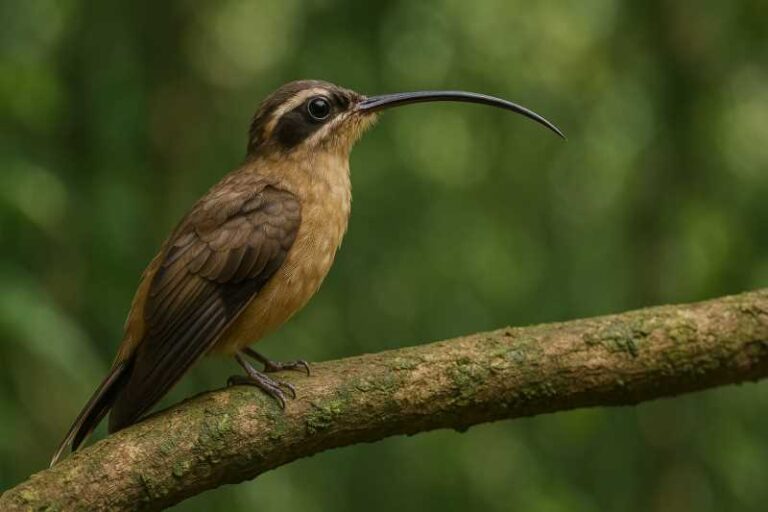
The Lucifer Sheartail is a small hummingbird, measuring about 8–10 cm in length and weighing approximately 3–4 g. Both sexes have a green back, a relatively large head, a long bill that curves distinctly downwards and a narrow tail that extends beyond the wing tips.
Adult males have a brilliant iridescent gorget, usually appearing purple but sometimes reflecting pink, violet, bronze or other colours in strong light. The breast is pale and the tail is deeply forked, although the fork may be difficult to see when the tail is closed.
Females lack the male’s purple throat. They are green above and pale or warm buff below, often with a cinnamon wash across the throat, breast and flanks. A pale line behind the eye can also be visible. Immature males resemble females but may develop scattered purple feathers on the throat before acquiring the full adult plumage.
Range and Habitat
The Lucifer Sheartail occurs mainly in northern and central Mexico, with a limited breeding distribution extending into extreme southern Arizona, south-western New Mexico and west Texas. Birds occurring in the United States are generally present from about March to September, while many individuals move southwards into Mexico for the non-breeding season.
In the United States, it is associated with Chihuahuan Desert foothills, dry canyons, washes, rocky slopes and scrub at approximately 1,070–1,675 metres. Important habitat features include agave, sotol, ocotillo, cholla, lechuguilla and other flowering plants. In Mexico, it also uses comparable scrub, pine-oak woodland and tropical deciduous forest in suitable canyon habitats.
The species is not endemic to the United States. Most of its range lies in Mexico, and the extent and regularity of seasonal movement vary geographically.
Where to See This Species
Big Bend National Park, Texas, United States
Big Bend National Park is one of the most reliable publicly accessible places in the United States to look for the Lucifer Sheartail. The National Park Service identifies the species as a spring and summer speciality, and suitable areas include flowering desert slopes, dry canyons, the Chisos Mountains and sections of the Ross Maxwell Scenic Drive. Watch flowering agaves and other nectar plants, particularly during the warmer months.
Nearby accommodation: Terlingua and Study Butte are the main gateway communities, with hotels, guest houses, lodges, cabins, campsites and self-catering accommodation available in the wider area.
Guadalupe Mountains National Park, Texas, United States
The Lucifer Sheartail is recorded on the Guadalupe Mountains National Park bird list, where it occurs as an uncommon seasonal species. Dry foothills, desert scrub and flowering plants around developed areas and lower-elevation trails offer the most suitable conditions for searching. Sightings are more likely during the warmer part of the year, especially where agave, yucca and other nectar-producing plants are flowering.
Nearby accommodation: Salt Flat is the closest small settlement, while Van Horn provides a wider choice of hotels, motels, guest houses and other accommodation.
Behaviour and Diet
Lucifer Sheartails are usually solitary and defend feeding areas from other hummingbirds. They hover while feeding, make rapid direct flights between flowers and may dart into the air to catch insects. Males can chase other hummingbirds, including Black-chinned Hummingbirds, from productive flower patches. Females also defend nest sites against potential predators and competitors.
The diet consists mainly of nectar from flowering plants such as agave, penstemons, paintbrushes, trumpet flowers, cholla and anisacanth. The birds also take small insects and spiders, particularly when feeding growing young. Agave flowers may provide important nectar, although Lucifer Sheartails can obtain nectar without necessarily pollinating the plant.
Breeding displays are performed near the female’s nest rather than at a communal display site. The male approaches the female, moves rapidly from side to side, rises high into the air and then dives steeply. Wing and tail sounds may accompany the display. The species does not form long-term pair bonds, and the male provides no parental care.
The female builds a small cup-shaped nest, usually on cholla, ocotillo or lechuguilla on a steep, dry slope. A clutch normally contains two white eggs. Incubation lasts about 15 days, and the young remain in the nest for approximately 22–24 days.
Identification Tips
Look for the following combination of features:
- A small, compact hummingbird with a long, strongly down-curved bill.
- A narrow, elongated tail that extends beyond the wing tips.
- A male with a brilliant purple gorget that may look dark or dull when it is not catching the light.
- A female or immature bird with a green back, pale underparts and a noticeable cinnamon wash.
- A preference for dry canyons, rocky hillsides and flowering desert vegetation.
The long curved bill and narrow forked tail are particularly useful. Black-chinned Hummingbirds may occur in the same habitats, but they generally have a shorter, less distinctly curved bill. Female Lucifer Sheartails are often warmer and buffier below than female Black-chinned Hummingbirds, and their long forked tails extend noticeably beyond the wing tips.
Conservation Status
The Lucifer Sheartail is classified as Least Concern on the IUCN Red List. However, its status does not mean that local populations are free from risk. Habitat loss and degradation, urban development, agricultural expansion and the decline of native flowering plants may reduce suitable feeding and nesting habitat. Climate change and changes in flowering patterns may also affect the availability of nectar in arid environments.
Population trends are not well documented across the entire range. Conservation priorities include protecting desert scrub and canyon habitats, maintaining native flowering plants, safeguarding migratory and breeding areas, and improving monitoring in both Mexico and the United States. Responsible management of supplementary feeders may assist local birds, but it should not replace the protection of natural habitat.
Frequently Asked Questions
What is the scientific name of the Lucifer Sheartail?
The scientific name of the Lucifer Sheartail is Calothorax lucifer. It is also widely known as the Lucifer Hummingbird.
Where does the Lucifer Sheartail live?
It occurs mainly in northern and central Mexico, with a limited seasonal range in southern Arizona, south-western New Mexico and west Texas. It favours dry canyons, desert foothills, rocky slopes and flowering scrub.
Is the Lucifer Sheartail migratory?
Many birds breeding in the United States move south into Mexico for the non-breeding season. The species is present in the United States mainly from March to September, although movement patterns vary across its range.
What does the Lucifer Sheartail eat?
It feeds mainly on nectar from desert flowers, including agave, penstemon, paintbrushes, trumpet flowers and cholla. It also catches small insects and spiders, which are especially important for nestlings.
How can the Lucifer Sheartail be identified?
The most useful field marks are its long down-curved bill, narrow forked tail and, in adult males, a brilliant purple throat. Females are green above and pale to buff below, often with cinnamon-coloured markings.
Is the Lucifer Sheartail endangered?
No. The species is currently classified as Least Concern, although habitat loss, degradation and reduced availability of native flowering plants remain important local conservation concerns.
References
- Cornell Lab of Ornithology
- National Park Service
- IUCN Red List of Threatened Species
Related posts