Introduction
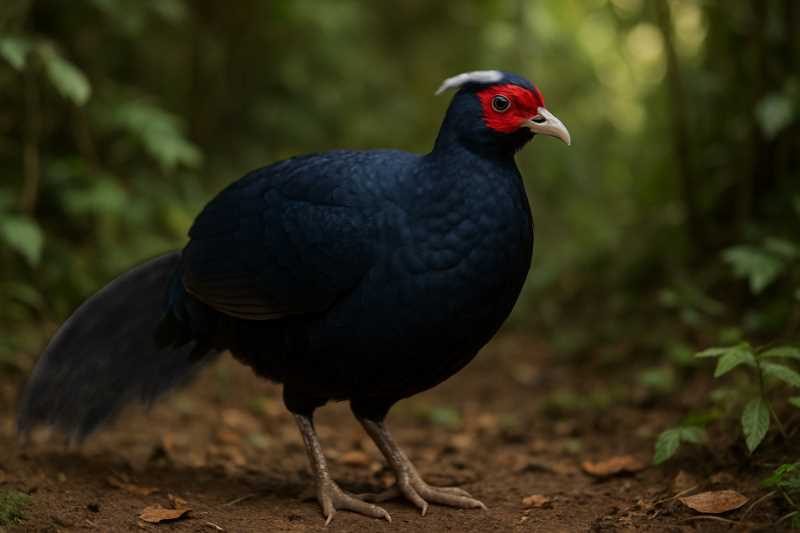
Edwards’s Pheasant (Lophura edwardsi) is a pheasant endemic to central Vietnam. It is a medium-sized, ground-dwelling forest bird recognised for the male’s glossy blue-black plumage, short crest and red facial skin. The species is also referred to in some recent conservation and taxonomic sources as the Vietnam Pheasant, following the treatment of the former Vietnamese Pheasant (Lophura hatinhensis) as a phenotype of Lophura edwardsi rather than a separate species.
Physical Description
Edwards’s Pheasant measures approximately 58–65 centimetres in total length. Males are larger and more strikingly coloured, with glossy dark blue-black plumage, a short white crest, red facial skin and red legs. The tail is generally dark blue, although birds showing white central tail feathers have been associated with the phenotype formerly called the Vietnamese Pheasant.
Females are smaller and mainly brown, with mottled, cryptic plumage that helps them remain concealed while nesting and foraging. The sexes are therefore readily distinguished in adult plumage. Detailed information on juvenile and age-related plumage changes is limited because the species is extremely difficult to study in the wild.
Range and Habitat
Edwards’s Pheasant is endemic to central Vietnam, on the eastern side of the Annamite mountain range. Historical records extend from Quang Binh and Quang Tri southwards to the Hai Van Pass in Thua Thien Hue. Records associated with the former Vietnamese Pheasant extend farther north, particularly into Ha Tinh and adjacent areas, but these birds are now generally treated as part of the same species.
The species is associated with very wet, broad-leaved evergreen forest at low elevations. Available records place it mainly below 300 metres, although older sources reported elevations as high as approximately 600 metres. It is a sedentary species rather than a regular migrant.
Much of the original lowland forest has been cleared or severely altered. Remaining forest has also been fragmented by logging, agriculture, roads and other human activities. The species appears to require dense, humid forest with suitable low vegetation, palms, rattan and bamboo-rich understorey.
Behaviour and Diet
Edwards’s Pheasant is secretive and primarily terrestrial. Like other Lophura pheasants, it is expected to spend much of its time moving quietly through dense undergrowth and to rely on running into cover when disturbed rather than flying. Direct observations of wild birds are now exceptionally rare, so many details of its behaviour remain uncertain.
Its diet is understood to include plant material such as seeds and fruits, together with small invertebrates collected from the forest floor. The precise proportions of these food types and the species’ seasonal feeding patterns have not been adequately documented in the wild.
Breeding biology is also poorly known. Conservation breeding programmes have shown that captive management, careful pedigree recording and, where possible, parent-rearing are important for retaining natural behaviour and preparing birds for any future reintroduction programme.
Identification Tips
- Look for a medium-sized pheasant moving through dense, humid lowland forest rather than in open habitat.
- An adult male has glossy blue-black plumage, a short white crest, red facial skin and red legs.
- An adult female is much plainer, mainly brown and mottled, with effective camouflage.
- The species is usually encountered on or near the ground and may remain hidden in thick understorey.
- The former Vietnamese Pheasant was distinguished chiefly by white central tail feathers, but this form is now generally treated as an inbred or otherwise variable phenotype of Lophura edwardsi, not as a separate species.
Conservation Status
The IUCN Red List classifies Edwards’s Pheasant as Critically Endangered, with the additional qualifier Possibly Extinct in the Wild, recorded as CR(PEW) in the 2024-2 assessment. The wild population size is not reliably known, and the current population trend cannot be quantified with confidence.
The principal threats are the loss and fragmentation of wet lowland forest, logging, agricultural clearance and hunting or indiscriminate snaring. Habitat was also affected by the extensive use of herbicides and the wider destruction associated with the Vietnam War. Hunting remains a serious concern even where forest cover has recovered, because restored vegetation does not necessarily provide secure habitat if trapping continues.
The species was rediscovered in central Vietnam in 1996 after decades without confirmed records, not in 2012 as sometimes stated. However, subsequent evidence has remained extremely limited. The last generally accepted reliable record of a living wild bird dates from around 2000, and later surveys have not established the continued existence of a viable wild population.
Conservation measures include protection and restoration of remaining forest, camera-trap surveys, removal of snares, improved management of protected areas, community engagement and international conservation breeding. Captive populations are managed through studbooks and genetic assessment because their founders were few and the population has a narrow genetic base. Any reintroduction would require secure habitat, effective control of hunting, genetic management, disease precautions and extensive preparation of captive-bred birds for life in the wild.
Frequently Asked Questions
Where does Edwards’s Pheasant live?
It is endemic to central Vietnam, where it historically occupied very wet, low-elevation evergreen forests on the eastern side of the Annamite range.
Is Edwards’s Pheasant extinct in the wild?
It is not formally classified as Extinct in the Wild by the IUCN, but it is listed as Critically Endangered with the qualifier Possibly Extinct in the Wild. No viable wild population has been confirmed in recent decades.
What does Edwards’s Pheasant look like?
The male is glossy blue-black with a short white crest, red facial skin and red legs. The smaller female is mainly brown and mottled, providing camouflage in forest undergrowth.
What does Edwards’s Pheasant eat?
Its diet is believed to include seeds, fruits and small invertebrates gathered from the forest floor, although detailed information from wild birds is scarce.
Why is Edwards’s Pheasant threatened?
The major threats are the destruction and fragmentation of lowland forest, logging, agricultural clearance and hunting or snaring. Historical damage from wartime herbicide use also contributed to the loss of suitable habitat.
Can captive-bred Edwards’s Pheasants be returned to the wild?
Reintroduction is being considered as part of long-term conservation planning, but it would only be appropriate where suitable habitat is protected and hunting threats are controlled. Captive birds also require genetic management and preparation for predator avoidance and other natural behaviours.
References
- International Union for Conservation of Nature. 2024. The IUCN Red List of Threatened Species: 2024-2, Table 7, Birds. IUCN, Gland, Switzerland. https://nc.iucnredlist.org/redlist/content/attachment_files/2024-2_RL_Table_7.pdf. Accessed 8 September 2026.
- Gill, F., Donsker, D. & Rasmussen, P. (eds.). 2026. IOC World Bird List, version 15.2. International Ornithologists’ Union. https://www.worldbirdnames.org/. Accessed 8 September 2026.
- Hennache, A., Mahood, S. P., Eames, J. C. & Randi, E. 2012. Lophura hatinhensis is an invalid taxon. Forktail 28: 129–135.
- Eames, J. C. & Mahood, S. P. 2017. Is Edwards’s Pheasant Lophura edwardsi extinct in the wild? Forktail 33: 27–33. https://sawfish-kazoo-6w4a.squarespace.com/s/Edwards-Pheasant.pdf. Accessed 8 September 2026.
- Grainger, M. J., Ngoprasert, D., McGowan, P. J. K. & Savini, T. 2019. Informing decisions on an extremely data poor species facing imminent extinction. Oryx 53(3): 484–490. https://doi.org/10.1017/S0030605317000813.
- Collar, N. J. 2020. Preparing captive-bred birds for reintroduction: the case of the Vietnam Pheasant Lophura edwardsi. Bird Conservation International 30(4): 559–574. https://doi.org/10.1017/S0959270920000039.
- Kapic, T., Rahde, T., Pinceel, L., Jacken, H., Roels, I., Phan Tuan Anh, Corder, J., Leus, K. & van Lint, W. 2020. Long-term management plan for the Vietnam Pheasant (Lophura edwardsi): Global Ex situ Programme. European Association of Zoos and Aquaria, Amsterdam. https://media.eaza.net/uploads/Vietnam_Pheasant_Best_Practice_Guidelines_FINAL_version1_1_482812aa33.pdf. Accessed 8 September 2026.
Related posts