Introduction
The Brazilian Merganser, Mergus octosetaceus, is a highly specialised river duck and one of the world’s rarest waterfowl. It depends on clear, fast-flowing freshwater rivers and streams, where it dives for fish and aquatic invertebrates. The species is now known mainly from scattered populations in central and south-eastern Brazil. Historical records also came from Paraguay and north-eastern Argentina, but it is considered extinct or functionally extinct across much of that former range.
Physical Description
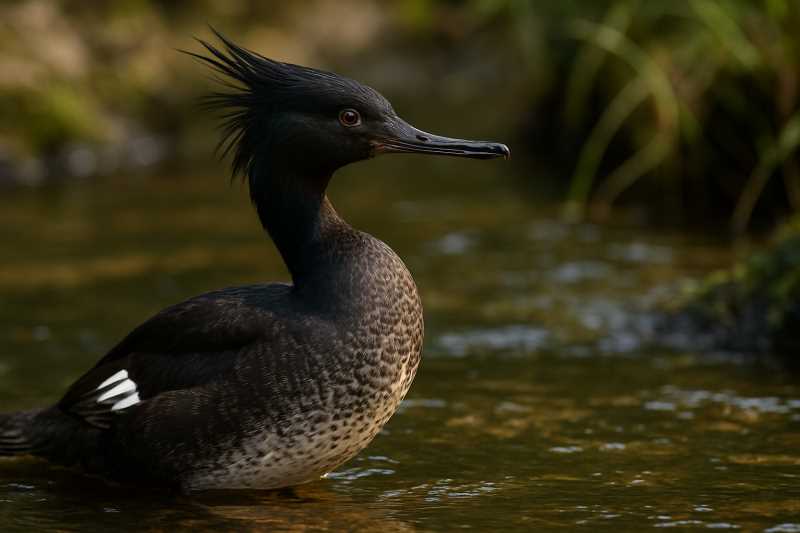
The Brazilian Merganser is a slender, medium-sized duck measuring approximately 49–54 cm in length. Adults have predominantly dark plumage with a glossy greenish-black head, a long, narrow bill adapted for catching aquatic prey, and an elongated crest. The body is grey to dark brown, with pale areas on the throat and upper breast that may be more noticeable in some individuals.
Males and females are similar in overall colouration, but males are generally larger and more robust, with a longer and fuller crest and a longer bill. Females usually have a shorter crest and a more delicate appearance. Juveniles lack the fully developed crest of adults and show paler facial and underpart markings. Young birds may also display a conspicuous pale eye-ring and contrasting wing-bars before acquiring adult plumage.
Range and Habitat
The Brazilian Merganser is endemic to South America. Confirmed surviving populations are concentrated in Brazil, particularly in parts of the São Francisco, Tocantins and upper Paraná river basins. Important areas include Serra da Canastra National Park in Minas Gerais and the Chapada dos Veadeiros region in Goiás, although the species has also been recorded in other Brazilian states.
Its preferred habitat consists of clear, shallow, fast-flowing rivers and streams with rapids, pools, exposed rocks, fallen trees and relatively undisturbed banks. Rivers may pass through gallery forest, cerrado or other native vegetation, but clear water and suitable flow conditions appear to be more important than any single vegetation type. The species has been recorded from low elevations to approximately 1,000 metres.
Brazilian Mergansers are generally sedentary. Pairs may occupy a defined stretch of river and are not known to undertake regular long-distance migration. Their dependence on particular river conditions makes them especially vulnerable to habitat fragmentation and changes in water flow.
Behaviour and Diet
The species is usually seen alone or in pairs, although family groups occur after breeding. It is shy and often rests on rocks, branches or fallen trees projecting from the water. When disturbed, it commonly flies low along the river, following the course of the channel.
Feeding is most active during the day, especially in the morning and late afternoon. The merganser dives and swims underwater in shallow, fast-flowing water, using its narrow, serrated bill to capture prey. Fish form the main part of the adult diet, supplemented by aquatic insects, insect larvae, snails and other aquatic invertebrates. Ducklings initially take more invertebrates, with fish becoming increasingly important as they grow.
Breeding has been recorded mainly during the dry-season months, although timing varies between localities. The species nests in cavities near rivers, including natural hollows in trees and other sheltered sites. Clutches of approximately four to six eggs have been reported. The female undertakes most incubation and care of the young, while the male may remain nearby. Flightless young stay close to the adults and use riverside vegetation for cover when threatened.
Identification Tips
When viewed on a river, look for the following combination of features:
- A slim, dark duck on clear, fast-moving water.
- A long, narrow bill and a noticeable crest.
- A glossy greenish-black head and generally dark upperparts.
- Frequent use of rocks, logs and low branches as resting places.
- Rapid diving and underwater pursuit of fish in shallow rapids.
- A tendency to fly close to the water and follow the river channel.
The species is unlikely to be confused with other mergansers in its restricted South American range. Its combination of dark plumage, long crest, slender body and association with clear rapids is particularly distinctive. A dark cormorant may appear similar at a distance, but cormorants have a different bill shape, posture and wing profile, and they do not show the Brazilian Merganser’s characteristic crest.
Conservation Status
The Brazilian Merganser is classified as Critically Endangered (CR). The total population is generally estimated at fewer than 250 mature individuals, although precise numbers are difficult to establish because the remaining birds occur in small, isolated groups.
The main threats are the loss and degradation of river habitat, increasing sedimentation and turbidity, deforestation in catchments, agricultural expansion, mining, pollution and the construction of dams and other hydropower infrastructure. Dams can alter natural flow patterns, inundate nesting and feeding areas, and isolate river populations. Uncontrolled tourism and disturbance near breeding sites may also reduce breeding success.
Conservation measures include protecting river corridors, maintaining native vegetation along catchments, monitoring known populations, improving water quality and assessing proposed developments before construction. Brazil’s National Action Plan for the species also supports ecological and genetic research, habitat protection, environmental education and the maintenance of a genetically diverse captive population as a potential source for future reinforcement or reintroduction programmes. Long-term recovery will depend on protecting connected, clean and free-flowing rivers rather than relying on isolated reserves alone.
Frequently Asked Questions
Where does the Brazilian Merganser live?
It lives in clear, shallow, fast-flowing rivers and streams, mainly in central and south-eastern Brazil. Historical records came from Paraguay and north-eastern Argentina, but surviving populations are now concentrated in Brazil.
What does the Brazilian Merganser eat?
Fish are the principal food of adults. The species also takes aquatic insects, insect larvae, snails and other aquatic invertebrates, especially when young birds are feeding.
Is the Brazilian Merganser migratory?
No regular long-distance migration is known. Pairs are generally associated with particular river stretches and appear to be largely sedentary.
How can the Brazilian Merganser be identified?
It is a slender, dark duck with a glossy greenish-black head, a long narrow bill and a distinctive crest. It is usually found diving or resting along clear, rapid rivers.
Why is the Brazilian Merganser endangered?
Its specialised river habitat is threatened by deforestation, sedimentation, pollution, agricultural development, mining, dams, altered water flow and disturbance. Small, isolated populations are particularly vulnerable to further habitat loss.
How is the species being conserved?
Conservation includes protected areas, river and water-quality management, population surveys, research, environmental education and a coordinated national action plan. Captive management is also being developed as a safeguard for the species and a possible source of birds for future conservation programmes.
References
- BirdLife International. 1992. “Brazilian Merganser Mergus octosetaceus.” In Threatened Birds of the Americas: The ICBP/IUCN Red Data Book, regional species account. BirdLife International. Available at: https://birdlifedata.blob.core.windows.net/red-data-books/Mergus_octosetaceus_eng.pdf (accessed 8 September 2026).
- Instituto Chico Mendes de Conservação da Biodiversidade. 2018. Portaria nº 122, de 8 de fevereiro de 2018: Aprova o 2º Ciclo do Plano de Ação Nacional para a Conservação do Pato-mergulhão. ICMBio, Brasília. Available at: https://www.gov.br/icmbio/pt-br/assuntos/biodiversidade/pan/pan-pato-mergulhao/2-ciclo/pan-pato-mergulhao-portaria-aprovacao.pdf (accessed 8 September 2026).
- Instituto Chico Mendes de Conservação da Biodiversidade. 2019. Plano de Ação Nacional para Conservação do Pato-mergulhão: Sumário executivo. ICMBio, Brasília. Available at: https://www.gov.br/icmbio/pt-br/assuntos/biodiversidade/pan/pan-pato-mergulhao/2-ciclo/pan_pato_mergulhao_sumario-1.pdf (accessed 8 September 2026).
- Silveira, L. F., Ribeiro, F. and Lins, L. 2018. “Mergus octosetaceus Vieillot, 1817.” In Livro Vermelho da Fauna Brasileira Ameaçada de Extinção, Volume III. Instituto Chico Mendes de Conservação da Biodiversidade, Brasília. Available at: https://www.gov.br/icmbio/pt-br/centrais-de-conteudo/publicacoes/publicacoes-diversas/livro_vermelho_2018_vol3.pdf (accessed 8 September 2026).
- Silveira, L. F. and Bartmann, W. D. 2001. “Natural history and conservation of Brazilian Merganser Mergus octosetaceus at Serra da Canastra National Park, Minas Gerais, Brazil.” Bird Conservation International 11(4): 287–300. https://doi.org/10.1017/S0959270901000338.
- Gill, F., Donsker, D. and Rasmussen, P., eds. 2026. IOC World Bird List, version 15.2. International Ornithologists’ Union. Available at: https://www.worldbirdnames.org/ (accessed 8 September 2026).
Related posts