Introduction
The Pacific Emerald Dove (Chalcophaps longirostris) is a small, secretive pigeon of tropical and subtropical forests, woodlands and coastal vegetation. It is also known as the Brown-capped Emerald Dove and was formerly treated as part of a wider Emerald Dove species complex. Despite its brilliant wing colour, it is often detected by its soft calls or sudden wing-clatter before it is seen.
Physical Description
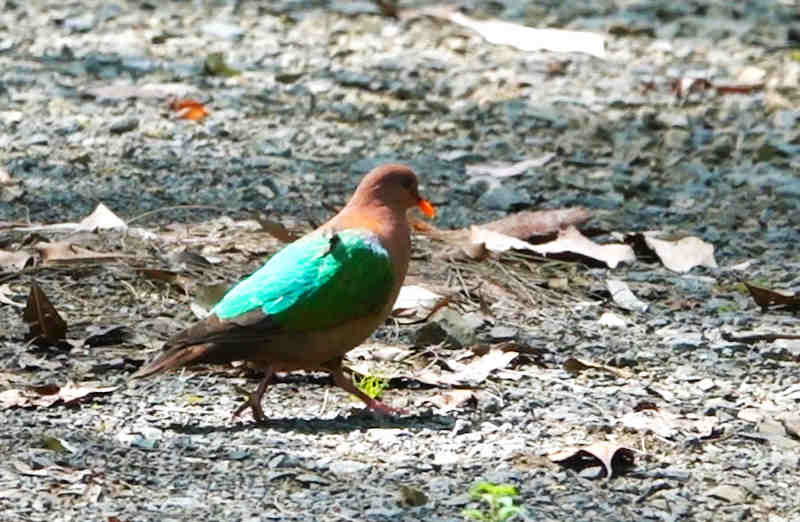
The Pacific Emerald Dove is a compact, short-tailed pigeon measuring approximately 23–28 centimetres in length. Its back and wings are glossy emerald-green, while the head and underparts are mainly brown to purplish-rufous. A pale shoulder patch contrasts with the darker wing, and the flight feathers and tail appear blackish in flight. Pale barring may also be visible across the lower back when the bird takes off.
The bill is reddish-orange, and the legs and feet are reddish. Males are generally more brightly coloured than females, particularly on the crown and shoulder. Females are usually duller and may show a less conspicuous pale shoulder patch. Juveniles are browner and more heavily scalloped, with less developed iridescent green plumage.
Range and Habitat
The Pacific Emerald Dove is a resident species found from eastern Indonesia and Timor-Leste through New Guinea and northern and eastern Australia, with additional populations on islands of the western Pacific. Its distribution includes tropical and subtropical regions rather than a single continuous habitat zone.
It favours rainforest, wet woodland, dense secondary growth, mangroves, coastal heath and forest edges. It may also occur in gardens, farms and other lightly modified areas where dense cover and suitable feeding habitat remain. The species is usually encountered on or near the ground, particularly along quiet tracks, clearings and shaded margins. It is generally sedentary, although local movements may occur in response to food availability and seasonal conditions.
Where to See This Species
Carnarvon National Park, Queensland, Australia
The Pacific Emerald Dove is documented in Carnarvon National Park, where suitable habitat includes shaded woodland, dense vegetation and forested sections around the Carnarvon Gorge area. Look quietly along tracks and sheltered edges, especially during the cooler parts of the day, when ground-feeding birds may be more active.
Nearby accommodation: Camping, cabins and lodge-style accommodation are available around the Carnarvon Gorge visitor area, with further accommodation in the nearby towns of Injune and Rolleston.
Clump Mountain National Park, Queensland, Australia
Clump Mountain National Park contains tropical rainforest and dense vegetation suitable for Pacific Emerald Doves, and the species is recorded in the park’s wildlife inventory. Walk slowly along forest margins and quiet paths, listening for calls and watching shaded ground beneath the vegetation.
Nearby accommodation: Mission Beach is the practical gateway, with hotels, guest houses, holiday apartments, cabins and caravan parks.
Coalstoun Lakes National Park, Queensland, Australia
The species is recorded from Coalstoun Lakes National Park, where patches of woodland and denser vegetation provide potential feeding and cover habitat. The dove is unobtrusive, so patient observation along lightly used tracks and vegetated edges is more productive than scanning open ground.
Nearby accommodation: Biggenden is the nearest recognised service town, with additional hotels, motels, cottages and self-catering accommodation available in the wider North Burnett region.
Behaviour and Diet
The Pacific Emerald Dove is primarily a ground-feeding bird. It walks with a deliberate, purposeful gait while searching through leaf litter and low vegetation for fallen fruit, berries, seeds and other plant material. Small invertebrates may also be taken, although plant foods form the main part of its diet.
It is usually seen alone or in pairs, although several birds may gather where food is concentrated. The species is secretive and often remains motionless beneath dense cover. When disturbed, it commonly runs or flushes low and fast with noisy wingbeats before disappearing into vegetation.
The call is a soft, mournful series of coos that may be difficult to hear in dense forest. During courtship, the male performs a bobbing display while calling. The nest is a sparse platform of twigs placed in a tree or shrub, usually only a few metres above the ground. Two cream-coloured eggs are laid, and both parents contribute to incubation and care of the young.
Identification Tips
- Look for a small, plump, short-tailed pigeon walking on the forest floor.
- The combination of brown head and underparts, iridescent green wings and a pale shoulder patch is distinctive.
- The reddish bill and reddish legs help separate it from many other forest pigeons.
- In flight, the dark wings and tail, pale back barring and sudden wing-clatter are useful clues.
- Do not confuse it with the Common Emerald Dove (Chalcophaps indica), which has a different geographic distribution and is generally associated with the Asian part of the Emerald Dove complex.
- The Pacific Emerald Dove is often heard before it is seen, particularly in rainforest and dense wet woodland.
Conservation Status
The Pacific Emerald Dove is currently assessed as Least Concern. It has a broad distribution and remains locally common in suitable habitat, although abundance varies between regions. The principal potential threats are the loss and fragmentation of rainforest and other dense habitats, together with local disturbance and changes in land use.
Protecting rainforest, wet woodland, mangroves and coastal vegetation helps maintain feeding and nesting habitat. Retaining dense cover along forest edges and limiting unnecessary disturbance on breeding and feeding sites are also beneficial conservation measures.
Frequently Asked Questions
Where does the Pacific Emerald Dove live?
It occurs across eastern Indonesia, Timor-Leste, New Guinea, northern and eastern Australia and parts of the western Pacific. It uses rainforest, wet woodland, mangroves, coastal heath, forest edges and some modified habitats with dense vegetation.
What does a Pacific Emerald Dove look like?
It is a compact, short-tailed pigeon with brown to purplish-rufous head and underparts, glossy emerald-green wings, a pale shoulder patch, a reddish bill and reddish legs. Males are generally brighter than females.
Is the Pacific Emerald Dove migratory?
It is generally a resident species rather than a long-distance migrant. Local movements may occur when birds respond to food availability, seasonal conditions or changes in habitat.
What does the Pacific Emerald Dove eat?
It feeds mainly on fallen fruit, berries and seeds found on the ground. It may also take small invertebrates while foraging through leaf litter and low vegetation.
How does the Pacific Emerald Dove breed?
The species builds a simple twig nest in a low tree or shrub and usually lays two cream-coloured eggs. Both parents participate in incubation and care of the young.
Why is the Pacific Emerald Dove difficult to see?
It is quiet, ground-dwelling and well camouflaged in shaded vegetation. Observers often hear its soft call or noisy flush before seeing the bird itself.
References
- IOC World Bird List
- BirdLife Australia, HANZAB Index+
- Queensland Government, Department of the Environment, Tourism, Science and Innovation
Related posts