Introduction
The Straight-billed Hermit (Phaethornis bourcieri) is a resident hummingbird of the northern Amazon Basin and Guianas. It belongs to the hummingbird family Trochilidae and is named for its unusually straight, slender bill. Its subdued plumage suits the shaded forest understory, where it feeds on nectar and small invertebrates.
Physical Description
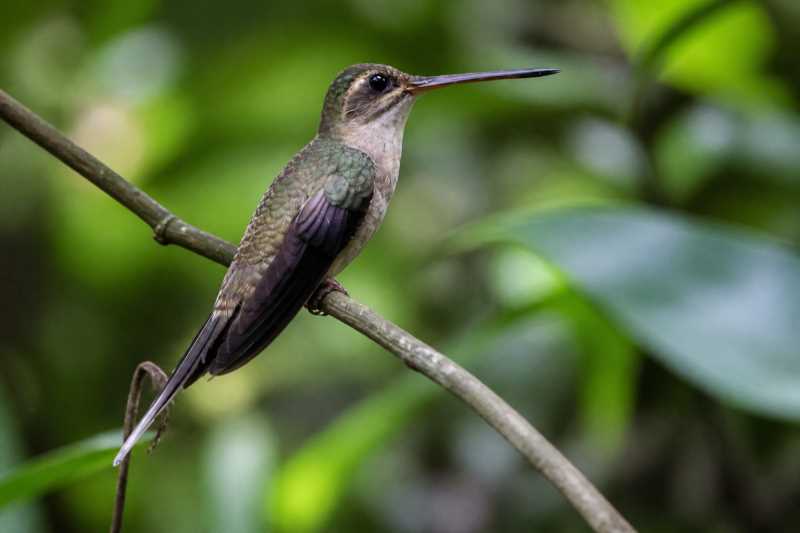
The Straight-billed Hermit is a medium-sized hermit hummingbird, measuring approximately 12–14 cm in length and weighing about 3.5–5 g. It has olive-green upperparts, greyish-brown or greyish underparts and a poorly defined dusky mask through the eye. Pale buff or whitish lines may border the mask.
The bill is straight rather than strongly curved. It is usually dark on the upper mandible, with a contrasting orange or reddish lower mandible. The tail is dark, with broad pale tips on most feathers. The central tail feathers are longer and also end in pale tips. These tail markings, together with the straight bill and greyish underparts, are useful identification features.
No consistent, obvious difference in plumage between adult males and females is generally used in field identification. Immature birds may show less distinct facial and tail markings, although detailed age-related information is limited.
Taxonomic treatment varies. Some authorities include the Amazonian form Phaethornis bourcieri major within the Straight-billed Hermit, while others treat it as a separate species, the Ash-bellied Hermit. The account here follows the broad species concept represented by Phaethornis bourcieri.
Range and Habitat
The Straight-billed Hermit occurs in the northern and western Amazon Basin and across the Guianas. Its range includes parts of southern Venezuela, Guyana, Suriname, French Guiana, northern Brazil, south-eastern Colombia, eastern Ecuador and north-eastern Peru. Under the broader taxonomic treatment, a separate population also occurs south of the Amazon in Brazil.
It is a non-migratory resident of humid lowland forest. The species is most often associated with the shaded understorey of mature rainforest, riverine forest, seasonally flooded forest, palm- and bamboo-rich vegetation and forest edges. It is generally recorded at low elevations, often below about 400 m, although local records may occur higher where suitable Amazonian forest continues.
The Straight-billed Hermit is not known for long-distance migration. Geographic variation occurs across its extensive range, and the status of some named forms remains linked to differing taxonomic interpretations.
Where to See This Species
Cuyabeno Wildlife Production Reserve, Sucumbíos, Ecuador
The Straight-billed Hermit is documented from Cuyabeno, including records held by Ecuador’s national biodiversity information system. The reserve’s extensive lowland rainforest, seasonally flooded forest and shaded trails provide suitable habitat, although the species is generally uncommon and may require patient searching along quiet forest paths and watercourses.
Nearby accommodation: Lago Agrio is the main practical gateway for hotels and guest houses, while authorised rainforest lodges and camps are available closer to the reserve.
Yasuní National Park, Orellana and Pastaza, Ecuador
Ecuador’s national biodiversity information system lists the Straight-billed Hermit from Yasuní National Park. The park protects large areas of lowland Amazonian rainforest, including the dense understorey and river-associated habitats favoured by hermit hummingbirds. Early morning observation along forest trails and lodge access routes offers the best opportunity.
Nearby accommodation: Coca is the principal gateway, with rainforest lodges, guided camps and other accommodation reached by river transport from the town.
Anavilhanas National Park, Amazonas, Brazil
The Straight-billed Hermit is included in the documented bird fauna of Anavilhanas National Park. The park protects an extensive complex of Amazonian river islands, flooded forest and mainland rainforest near the Rio Negro. Look for the species in shaded forest away from busy riverside areas, particularly where flowering plants occur.
Nearby accommodation: Novo Airão is the nearest practical base, with hotels, guest houses, lodges and river-oriented accommodation.
Behaviour and Diet
The Straight-billed Hermit is usually solitary and spends much of its time moving through dense vegetation. Like other hermits, it may follow a regular trapline, visiting a sequence of flowering plants repeatedly rather than defending a single feeding territory. Its rapid wingbeats allow it to hover briefly while taking nectar.
Nectar provides energy for flight and is taken from a variety of forest flowers. The bird also captures small insects and spiders, especially when additional protein is needed. By carrying pollen between flowers, it contributes to the reproduction of some Amazonian plants, although the importance of this service varies among plant species and habitats.
Breeding information for this species is limited. As in other hermits, the female is expected to build the nest and undertake incubation and most care of the young. Hermit hummingbird nests are commonly made from plant fibres, moss and spider silk and are often attached beneath leaves or other sheltered surfaces. Precise clutch size, incubation period and lifespan should not be assumed to be uniform across the species without site-specific evidence.
Identification Tips
- Look for a medium-sized, rather dull hermit hummingbird in shaded Amazonian understorey.
- The straight, slender bill is the most distinctive feature, especially when viewed in profile.
- Note the olive-green upperparts, greyish underparts and subdued facial mask.
- Broad pale tips on the dark tail are conspicuous when the bird flies or fans its tail.
- The lower mandible may appear orange or reddish, contrasting with the darker upper mandible.
- The Straight-billed Hermit can resemble the Needle-billed Hermit, but the Straight-billed Hermit has a straighter bill and generally greyer underparts. Care is needed because lighting, distance and taxonomic treatment can affect comparisons.
Conservation Status
The Straight-billed Hermit is classified as Least Concern on the IUCN Red List. The assessed population trend is described as stable, and the species has a very large geographic range.
Nevertheless, local populations may be affected by deforestation, forest fragmentation, fires, mining, agricultural expansion and other forms of human encroachment. Protecting extensive lowland rainforest, maintaining forest corridors and managing protected areas remain important conservation measures. The possible treatment of the southern Amazonian form as a separate species also has implications for regional conservation assessments.
Frequently Asked Questions
Where does the Straight-billed Hermit live?
It occurs in lowland forests of the northern and western Amazon Basin and the Guianas, including parts of Venezuela, the Guianas, Brazil, Colombia, Ecuador and Peru.
How can the Straight-billed Hermit be identified?
Look for a medium-sized hermit hummingbird with a straight bill, olive-green upperparts, greyish underparts, a subdued facial mask and pale-tipped dark tail feathers.
Is the Straight-billed Hermit migratory?
No. It is generally regarded as a resident species and is not known for regular long-distance migration.
What does the Straight-billed Hermit eat?
Its diet consists mainly of flower nectar, supplemented by small insects and spiders. It may visit a regular sequence of flowering plants during the day.
Where is the best place to see this hummingbird?
Lowland Amazonian rainforest reserves such as Cuyabeno Wildlife Production Reserve, Yasuní National Park and Anavilhanas National Park provide documented opportunities. It is usually uncommon and can be difficult to locate in dense vegetation.
Is the Straight-billed Hermit threatened?
The species is currently assessed as Least Concern, with a stable global population trend. Habitat loss and degradation remain important local threats, particularly where rainforest is cleared or fragmented.
References
- BirdLife International and IUCN Red List of Threatened Species
- Ecuador Sistema de Información de Biodiversidad
- Ramsar Sites Information Service
Related posts