The Crested Treeswift: A Spectacle of Grace and Adaptation
The Crested Treeswift (Hemiprocne coronata) is a captivating bird species that inhabits the lush and diverse tropical forests of South and Southeast Asia. Known for their elegant flight and distinctive crest, these birds have enthralled ornithologists and nature enthusiasts alike. In this article, we delve into the fascinating world of the Crested Treeswift, exploring its unique characteristics, habitat, behavior, and the conservation challenges it faces in a rapidly changing world.
Unique Characteristics
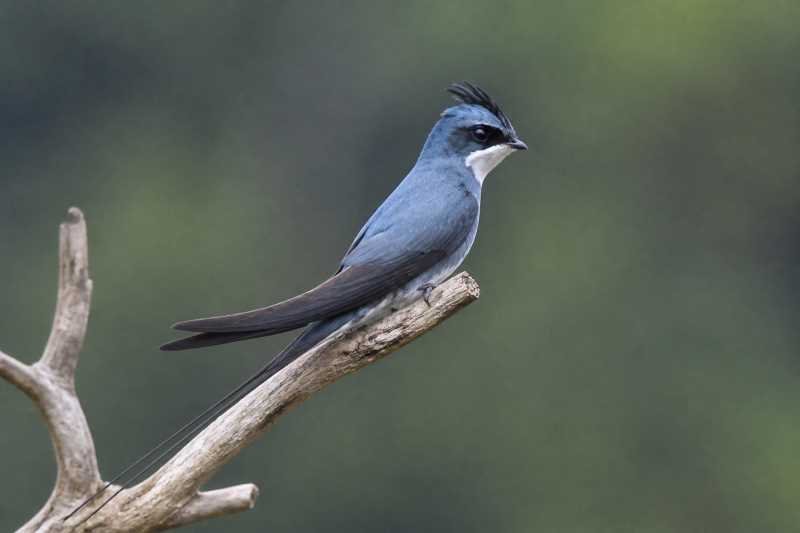
The Crested Treeswift is a medium-sized bird, measuring approximately 23 to 25 centimeters in length. One of its most distinguishing features is the impressive crest atop its head, which gives the bird its name. This crest is more pronounced in males, adding an element of sexual dimorphism to the species. The plumage of the Crested Treeswift is primarily a soft gray with a subtle blue tint, complemented by a white throat and underparts. The wings and tail are long and pointed, perfectly adapted for their agile flight.
A remarkable aspect of the Crested Treeswift is its specialized feet. Unlike most birds, treeswifts possess all four toes pointing forward, a unique adaptation that enables them to grip vertical surfaces. This anatomical feature allows them to perch on tree trunks and branches, where they spend much of their time resting or nesting.
Habitat and Distribution
The Crested Treeswift is found across a broad range encompassing the Indian subcontinent, including India, Sri Lanka, and Bangladesh, as well as parts of Southeast Asia, including Thailand, Myanmar, and Malaysia. They thrive in various habitats, from dense evergreen forests to open woodlands and even suburban gardens. Their adaptability to different environments has been a key factor in their broad distribution.
These birds are generally non-migratory, although some populations may undertake short-distance movements in response to food availability or climatic changes. The dense canopy of tropical forests provides the perfect environment for these aerial hunters to forage and breed.
Behavior and Diet
Crested Treeswifts are known for their graceful and acrobatic flight. They often glide effortlessly through the forest canopy, making sharp turns and dives as they hunt for insects. Their diet primarily consists of flying insects, including ants, beetles, and moths. They catch their prey mid-flight, demonstrating impressive aerial agility.
These birds are social creatures and are often observed in small family groups or loose flocks. They communicate through a series of high-pitched calls, which are used for maintaining contact with group members and signaling alarm.
Breeding and Nesting
The breeding season for the Crested Treeswift varies depending on the geographical location, but it typically occurs during the warmer months when food is abundant. These birds are monogamous, forming long-term pair bonds. The male engages in elaborate courtship displays, showcasing his flying skills and crest to attract a mate.
Nesting is a unique aspect of the Crested Treeswift’s biology. Unlike many birds that construct elaborate nests, treeswifts lay their eggs on a simple platform of saliva and feathers attached to a tree branch. The nest is so small that it can barely accommodate the single egg laid by the female. Both parents share incubation duties, and once hatched, the chick clings to the nest platform as it grows.
Conservation Status and Challenges
Although the Crested Treeswift is currently classified as a species of "Least Concern" by the International Union for Conservation of Nature (IUCN), it faces several conservation challenges. Habitat loss due to deforestation and land conversion for agriculture and urban development is a significant threat. Additionally, climate change poses a long-term risk by altering the availability of food resources and suitable habitats.
Conservation efforts are crucial to ensuring the survival of the Crested Treeswift. Protecting their natural habitats through the establishment and management of protected areas is imperative. Moreover, raising awareness about the ecological role of these birds and promoting sustainable land-use practices can help mitigate some of the threats they face.
Conclusion
The Crested Treeswift is a remarkable species that exemplifies nature’s ability to adapt and thrive. Its unique adaptations, coupled with its graceful presence in the skies, make it a species worth appreciating and conserving. As we continue to learn more about these fascinating birds, it is essential to prioritize their conservation and ensure that future generations can witness the beauty of the Crested Treeswift in its natural habitat.
Related posts