Introduction
The Djibouti Spurfowl (Pternistis ochropectus) is a Critically Endangered ground-dwelling bird in the pheasant family, Phasianidae. Endemic to Djibouti, it is associated mainly with remnant montane woodland in the Goda Massif, particularly the Forêt du Day, and has also been reported from the Mabla Mountains. The species was formerly widely known as the Djibouti Francolin, but the IOC World Bird List now uses Djibouti Spurfowl.
Physical Description
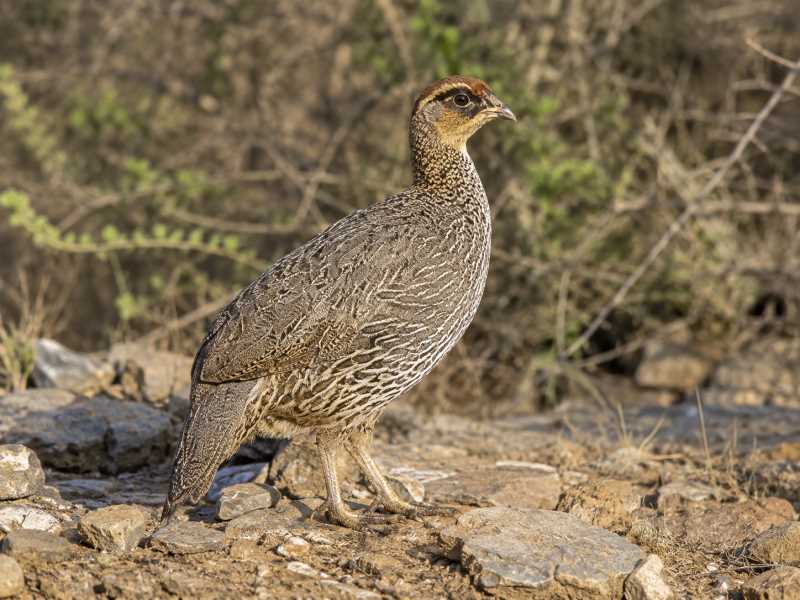
The Djibouti Spurfowl is a fairly large, rounded spurfowl measuring approximately 33–35 cm in length. It is generally greyish-brown, with darker upperparts and contrasting pale streaks and bars across the underparts. The head is grey, the nape has a slight rufous tone, and the throat and upper breast show warm ochre-brown colouring, reflected in the species name ochropectus, meaning ochre-breasted.
The sexes are reported to be broadly similar in appearance, although individual variation and limited knowledge of the species make detailed assessment of sexual and age-related differences difficult. Its strong legs and short, rounded wings reflect a largely terrestrial lifestyle, although birds may perch in low trees, particularly when roosting or avoiding disturbance.
Range and Habitat
The Djibouti Spurfowl is endemic to Djibouti and has a highly restricted range. Its principal stronghold is the Forêt du Day in the Goda Massif, where it occurs in dry Afromontane woodland and forested slopes at roughly 1,200–1,750 m. It has also been reported from the Mabla Mountains, approximately 80 km north-east of the Goda Massif, although the status of that population remains poorly known.
The species was historically associated with relatively dense African juniper (Juniperus procera) woodland, particularly on plateaux and in wooded valleys. Field research indicates that it is also found in areas with high overall tree cover dominated by boxwood (Buxus hildebrandtii) and other native trees. This suggests that structural cover may be more important than juniper alone, although the decline of the juniper woodland remains a major conservation concern.
The Djibouti Spurfowl is sedentary or largely resident. Claims of regular movement between lower and higher elevations have been made, but seasonal movements are not sufficiently documented to describe the species as migratory.
Behaviour and Diet
The Djibouti Spurfowl is secretive and usually occurs singly, in pairs or in small groups. It is primarily a ground-foraging bird and is most readily detected during the early morning, when it is more likely to call or move through open patches beneath the woodland canopy. When disturbed, it may retreat into dense vegetation rather than fly immediately.
Published accounts describe a mixed diet that includes seeds, berries, figs and termites. The bird forages by scratching through soil, leaf litter and other ground cover. Direct observations remain limited, so the relative importance of plant and animal foods is not well established.
Breeding information is also scarce. The species is considered probably monogamous, and nesting is thought to take place on the ground in a shallow depression concealed by grass, rocks or vegetation. Only very limited nest evidence has been documented, and reports of clutch size should be treated as unconfirmed. Breeding has been reported mainly between December and February.
Identification Tips
- Look for a large, rounded, greyish-brown spurfowl with pale streaking across the lower parts.
- Note the grey crown, subtly rufous nape and warm ochre tones on the throat and breast.
- Search beneath dense woodland, especially in areas with substantial tree cover, rather than in completely open terrain.
- Early-morning listening is often more productive than trying to locate a stationary bird visually.
- The species is unlikely to be confused with a common lowland gamebird within its restricted range, but its subdued plumage and secretive behaviour can make it difficult to distinguish from surrounding leaf litter and shadow.
Conservation Status
The Djibouti Spurfowl is listed as Critically Endangered on the IUCN Red List. Its population is believed to be declining, but a reliable current global population estimate is unavailable. Earlier surveys estimated approximately 285–450 birds in the Forêt du Day, while the status of the Mabla Mountains population remains uncertain. These historical estimates should not be treated as a current population count.
The main threat is the degradation and fragmentation of its remaining montane woodland. Juniper forest has been affected by prolonged drought, livestock grazing, fuelwood collection, timber extraction and other human pressures. Reduced tree cover and forest deterioration are associated with lower habitat quality, while the species’ very small range increases its vulnerability to drought, climate change, disease and local disturbances.
The Forêt du Day is protected as a national park, but protection alone does not remove the pressures affecting the forest. Recommended conservation measures include controlling grazing in sensitive areas, maintaining and expanding forest exclosures, restoring native trees, protecting remaining woodland patches, improving community-based land management and conducting regular population surveys. Conservation planning needs to address both the bird and the wider forest ecosystem on which it depends.
Frequently Asked Questions
Where does the Djibouti Spurfowl live?
It is endemic to Djibouti and is best known from the Forêt du Day in the Goda Massif. It has also been reported from the Mabla Mountains, although that population is less well studied.
Is the Djibouti Spurfowl the same bird as the Djibouti Francolin?
Yes. Djibouti Francolin is an older and still-used common name for Pternistis ochropectus. The IOC World Bird List currently uses Djibouti Spurfowl.
What does the Djibouti Spurfowl eat?
Its recorded and reported foods include seeds, berries, figs and termites. It forages mainly on the ground by scratching through soil, leaf litter and other ground cover.
How can the Djibouti Spurfowl be identified?
It is a large, rounded, greyish-brown spurfowl with pale streaking on the underparts, a grey crown, a subtly rufous nape and ochre tones on the throat and breast. Its shy behaviour and preference for dense woodland are also useful clues.
Why is the Djibouti Spurfowl threatened?
Its remaining habitat is extremely restricted and has been degraded by drought, livestock grazing, fuelwood collection, timber extraction and other human pressures. The species is also vulnerable because its populations are isolated and difficult to monitor.
What conservation work is being carried out?
Conservation work includes protection of the Forêt du Day, forest restoration, the use of livestock exclosures, native-tree planting, community engagement and surveys intended to improve knowledge of the species’ distribution and population.
References
- BirdLife International. n.d. “Djibouti Francolin Pternistis ochropectus.” BirdLife DataZone species factsheet. Accessed 8 September 2026. https://datazone.birdlife.org/species/factsheet/djibouti-francolin-pternistis-ochropectus
- Fisher, Z. S. Y., Cartwright, S., Bealey, C., Rayaleh, H. A., McGowan, P. and Milner-Gulland, E. J. 2009. “The Djibouti francolin and juniper forest in Djibouti: the need for both ecosystem and species-specific conservation.” Oryx, 43(4), 542–551. https://doi.org/10.1017/S0030605309990214
- Fuller, R. A., Carroll, J. P. and McGowan, P. J. K. 2000. Status Survey and Conservation Action Plan 2000–2004: Partridges, Quails, Francolins, Snowcocks, Guineafowl, and Turkeys. IUCN, Cambridge, UK.
- Gill, F., Donsker, D. and Rasmussen, P., eds. 2026. IOC World Bird List, version 15.2. International Ornithologists’ Union. Accessed 8 September 2026. https://www.worldbirdnames.org/
- Gouvernement de Djibouti. 2000. Monographie Nationale de la Diversité Biologique de Djibouti. Direction de l’Environnement, Ministère de l’Habitat, de l’Urbanisme, de l’Environnement et de l’Aménagement du Territoire, Djibouti.
- McGowan, P. J. K., Dowell, S. D., Carroll, J. P. and Aebischer, N. J. 1995. Partridges, Quails, Francolins, Snowcocks and Guineafowl: Status Survey and Conservation Action Plan, 1995–1999. IUCN, Gland, Switzerland.
- Cornell Lab of Ornithology. n.d. “Djibouti Spurfowl Pternistis ochropectus.” Birds of the World, species account, version 1.0. Accessed 8 September 2026. https://birdsoftheworld.org/bow/species/djifra1/cur/introduction
Related posts