The Enigmatic Brown Jacamar: A Jewel of the Rainforest
The Brown Jacamar (Brachygalba lugubris) is a remarkable bird native to the dense rainforests of South America. Known for its slender physique and striking plumage, the Brown Jacamar is a member of the Galbulidae family, which comprises small to medium-sized birds often characterized by vibrant colors and long bills. This article delves into the unique characteristics, habitat, behavior, and conservation status of this fascinating avian species.
Physical Characteristics
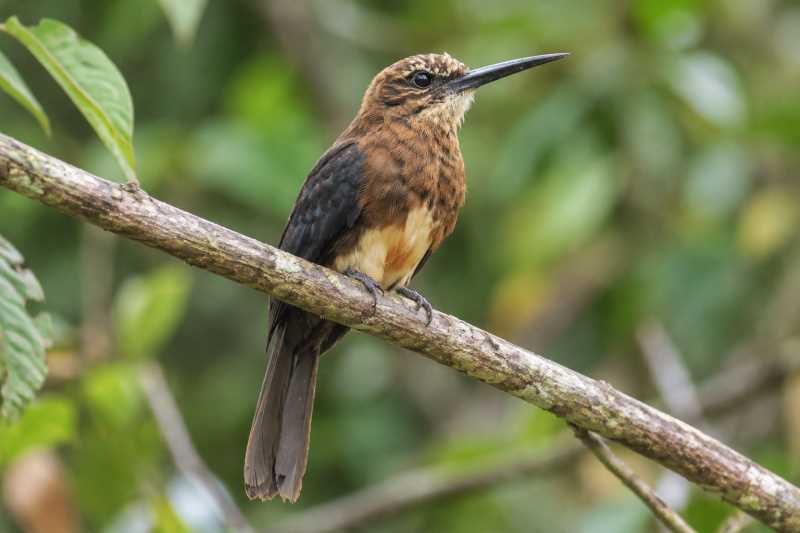
The Brown Jacamar is a small bird, typically measuring about 18-20 centimeters in length. Its slender body is adorned with a rich, cinnamon-brown plumage, which offers excellent camouflage against the earthy tones of its natural habitat. The bird’s long, pointed bill is perfectly adapted for its insectivorous diet, allowing it to snatch up prey with precision. A distinctive white throat and a subtle iridescent sheen on its upperparts add to its allure, making it an attractive subject for birdwatchers and ornithologists alike.
Habitat and Distribution
The Brown Jacamar is predominantly found in the tropical rainforests of South America, with its range extending across the Amazon Basin in countries such as Brazil, Colombia, Venezuela, and Peru. It prefers lowland forest edges and clearings, often inhabiting areas near rivers or streams. This preference for semi-open environments allows it to hunt effectively, as its primary prey consists of flying insects that are abundant in these regions.
Behavior and Diet
An agile hunter, the Brown Jacamar primarily feeds on insects, including butterflies, moths, dragonflies, and beetles. It employs a sit-and-wait hunting strategy, perching quietly on a branch and scanning for movement before darting out to capture its prey mid-flight. This method of foraging not only conserves energy but also capitalizes on the bird’s keen eyesight and swift flight.
Socially, Brown Jacamars are often observed in pairs or small family groups. They communicate through a series of sharp, high-pitched calls, which serve to establish territory and strengthen pair bonds. During the breeding season, these vocalizations become more frequent as pairs engage in courtship displays, which include mutual grooming and the presentation of food items by the male to the female.
Reproduction and Lifecycle
The breeding season of the Brown Jacamar typically coincides with the onset of the rainy season, which ensures a plentiful supply of food for the nestlings. Nesting sites are carefully chosen, often in sandy banks or termite mounds, where the birds excavate burrows to lay their eggs. A typical clutch consists of two to four eggs, with both parents sharing the responsibility of incubation and feeding the chicks.
The chicks are altricial at birth, meaning they are born naked and helpless, relying entirely on their parents for warmth and nourishment. As they grow, the young birds develop rapidly, fledging within a few weeks and gaining independence shortly thereafter. The relatively high success rate of fledging in Brown Jacamars is attributed to the secure nature of their nesting sites, which offer protection from many predators.
Conservation Status
Currently, the Brown Jacamar is classified as a species of Least Concern by the International Union for Conservation of Nature (IUCN). Its population is considered stable, and it benefits from the vast expanses of suitable habitat within the Amazon Basin. However, as with many rainforest species, the Brown Jacamar faces potential threats from deforestation and habitat fragmentation. Conservation efforts aimed at preserving large tracts of intact rainforest are crucial to ensuring the long-term survival of this and many other species.
The Importance of the Brown Jacamar
The Brown Jacamar plays a vital role in the ecosystem as both a predator and a prey species. By controlling insect populations, it helps maintain ecological balance within its habitat. Additionally, as a prey species for larger birds of prey, it contributes to the complex food web of the rainforest.
For bird enthusiasts and researchers, the Brown Jacamar offers valuable insights into the dynamics of tropical ecosystems. Studies of its behavior and ecology continue to shed light on the evolutionary adaptations that enable it to thrive in one of the planet’s most challenging environments.
Conclusion
The Brown Jacamar is a testament to the diversity and beauty of the Amazon rainforest. Its striking appearance and fascinating behaviors make it a cherished subject for ornithologists and birdwatchers. While its current conservation status is reassuring, ongoing efforts to protect its habitat are essential to ensure that future generations can continue to marvel at this remarkable bird. As we deepen our understanding of the Brown Jacamar, we also gain a greater appreciation for the intricate tapestry of life within the rainforest, underscoring the need for continued conservation and sustainable environmental practices.
Related posts